
Discover 16 inspiring welcome email examples and learn how to craft effective welcome emails that captivate new subscribers. Explore strategies to boost engagement, increase click-through rates, and drive revenue with personalized, well-designed messages. Uncover the anatomy of successful welcome emails, from compelling subject lines to impactful calls to action, and elevate your email marketing game.
Making a good first impression, whether on a first date or at a business meeting, is an endeavor with tons of moving parts. You want to care, but not too much. You want to be interesting, but there’s nothing worse than someone trying to be interesting.
It’s a head-spinning social balancing act that’s, in essence, no different from crafting welcome emails for your new email subscribers.
Your welcome email is the first step to having a lucrative, open line of communication with customers—as long as it’s done right.
In today’s post, we’ll take a look at 16 great welcome email examples and we’ll discuss how to put together an effective welcome message.
But first, let’s go over the basics of welcome emails.
What is a welcome email?
A welcome email is the first communication you send to someone who willingly signed up for your email marketing campaigns.
Welcome emails serve as a confirmation message to those new subscribers. But they should also introduce your brand and products—while setting the stage for future emails.
The content of a welcome email varies with different ecommerce businesses (as you’ll see in our welcome email examples). But usually, they feature a warm greeting and other common elements which include a discount code, helpful resources, and/or the company’s brand story.
Benefits of welcome messages in ecommerce
As an online store, you can expect to gain several benefits from sending out a great welcome email. New subscribers are happy to engage with your brand because they’re looking forward to getting a welcome email.
Welcome emails have a91.43% open rate—according to data from 2018. It’s42% higher than the average email from an online store.
The fact that you can expect the vast majority of new subscribers to open your email gives you a great opportunity to showcase your brand, products, and unique selling point.
In the long run, welcome emails generate33% more brand engagement than other types of email campaigns.
They also have very high click-through rates. And that leads to perhaps the most telling of all welcome email statistics: they generate320% more revenue than other types of email.
The 16 best welcome email examples we found and why they work
Now let's take a look at our list of the best welcome email examples we’ve come across. We hope you can find some inspiration that gets you started on your own welcome email.
1. LARQ
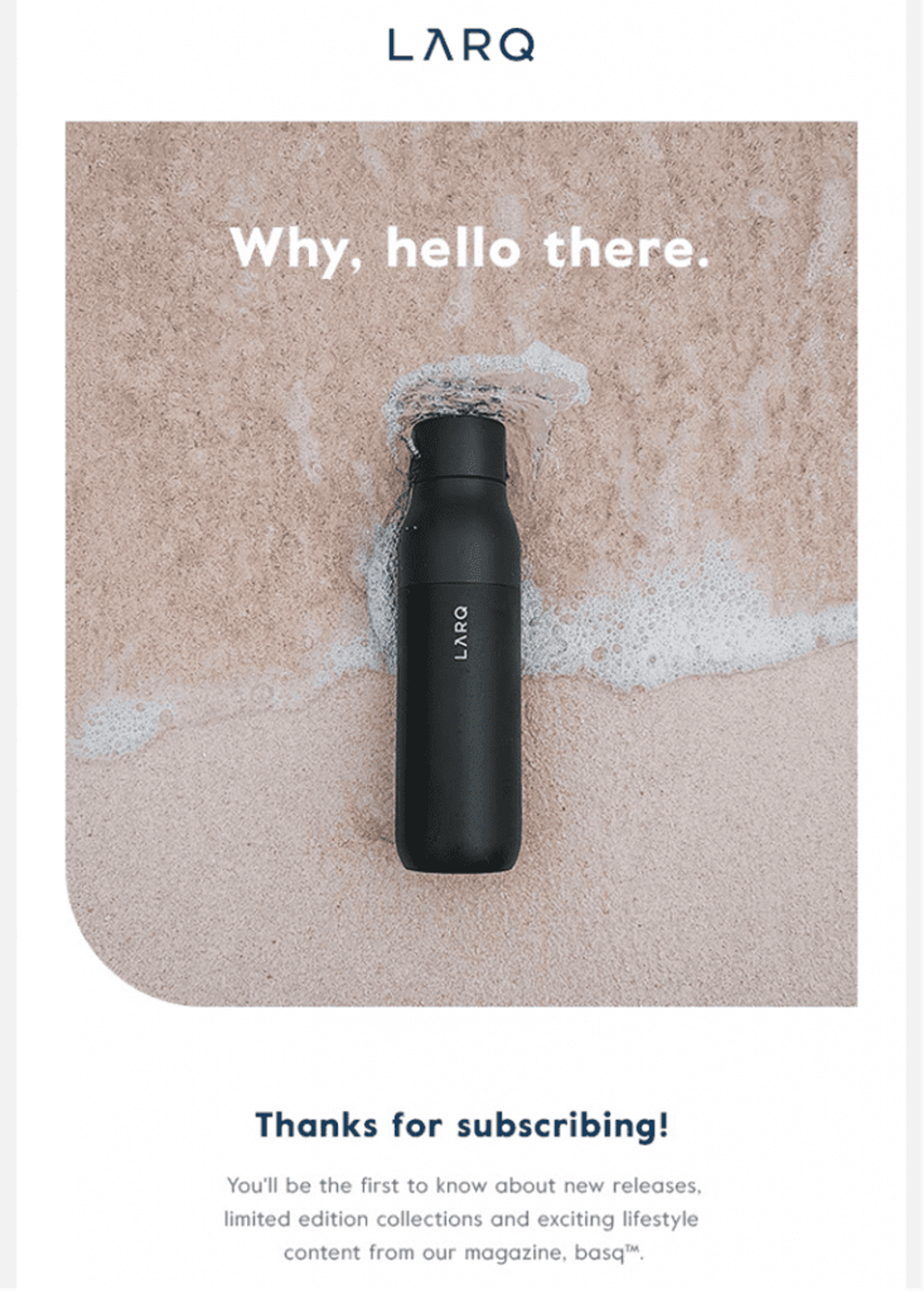
This welcome email example from LARQ perfectly illustrates the power of an image to define a brand. The photograph of a jet black bottle being covered by a wave establishes the brand as adventurous, outdoorsy, yet still stylish.
It also shows new subscribers what they can expect to see in the future.
2. Rituals
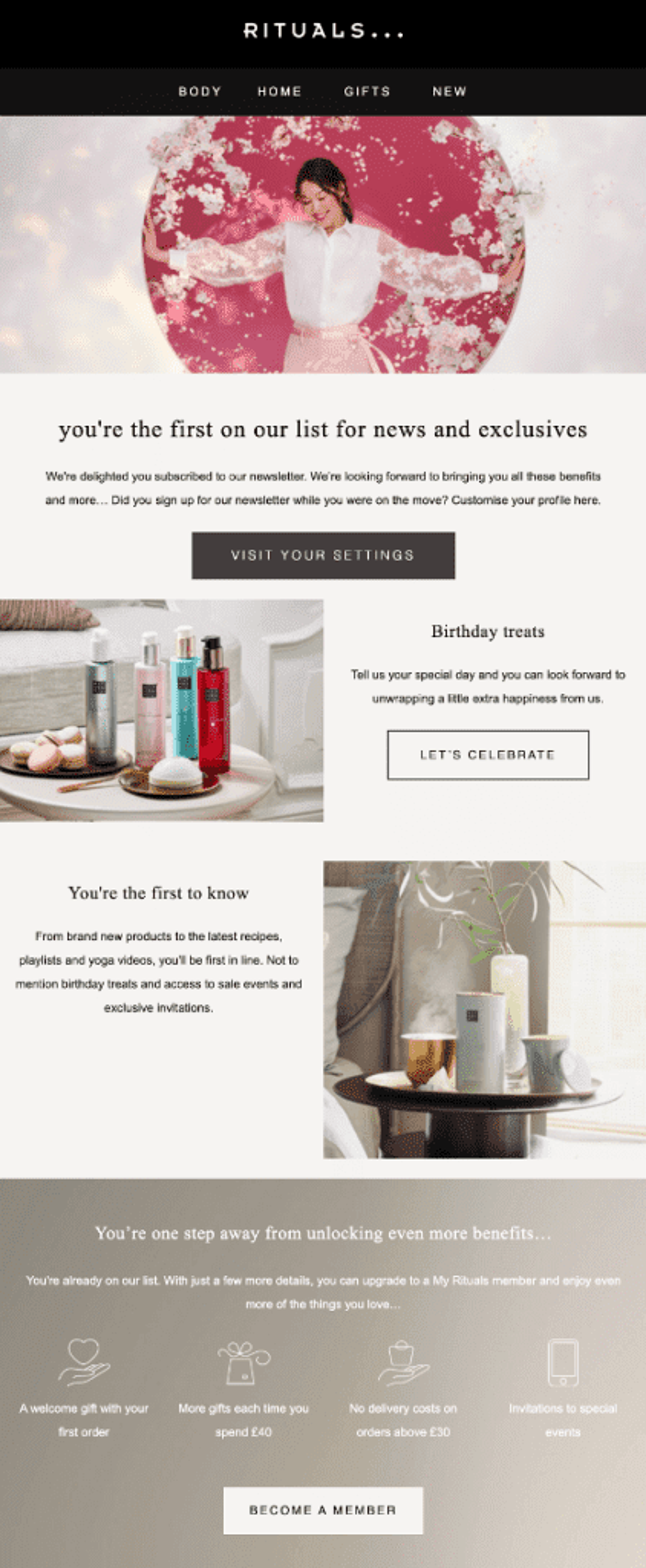
Rituals’ welcome email is a great example of conveying tons of information with relatively little text.
After introducing some of the benefits of being a subscriber, they use a list with icons to explain their membership to new customers.
3. Curology
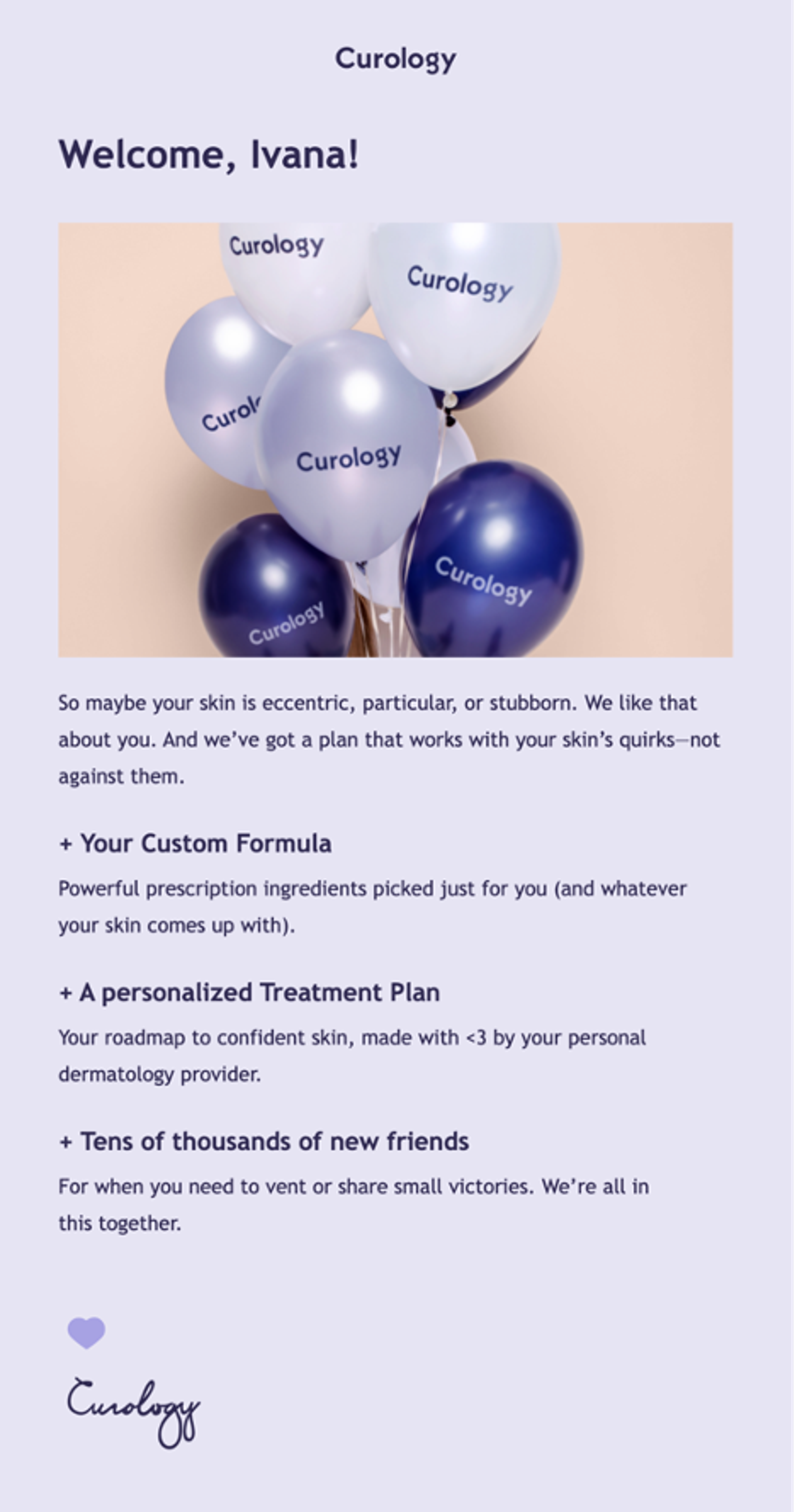
Curology’s beautiful welcome email is all about using color and design. They wanted to bring a calm spa experience to their reader.
It’s evident that email design can help sell products through emotion.
4. Gymshark

Gymshark uses a simple design that makes clicking their “Explore” call to action seem like the natural next step. Getting people to landing pages is a great outcome for a welcome email.
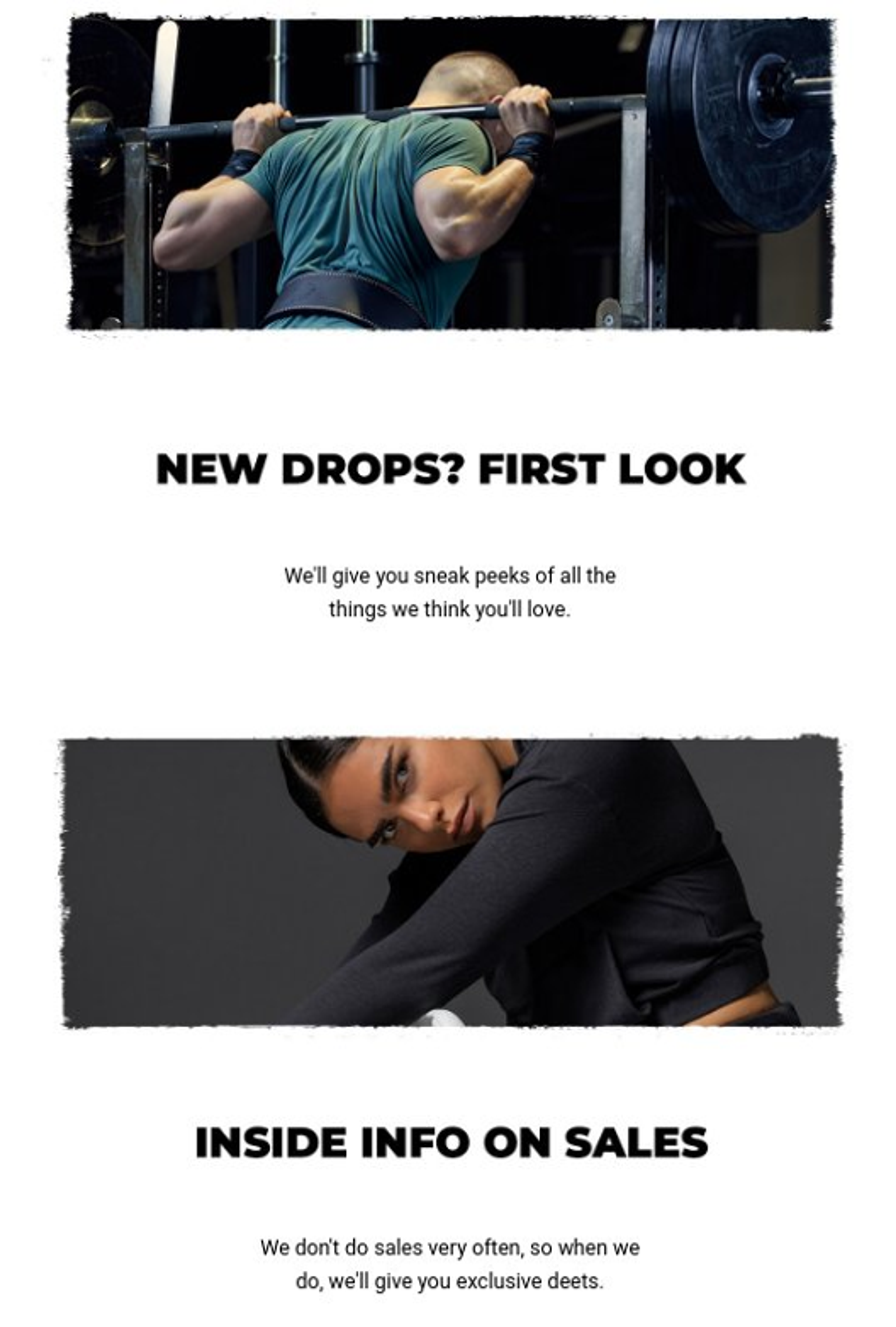
When the reader scrolls further down, this welcome email example pairs engaging photographs with previews of what's to come.
5. Hush Puppies
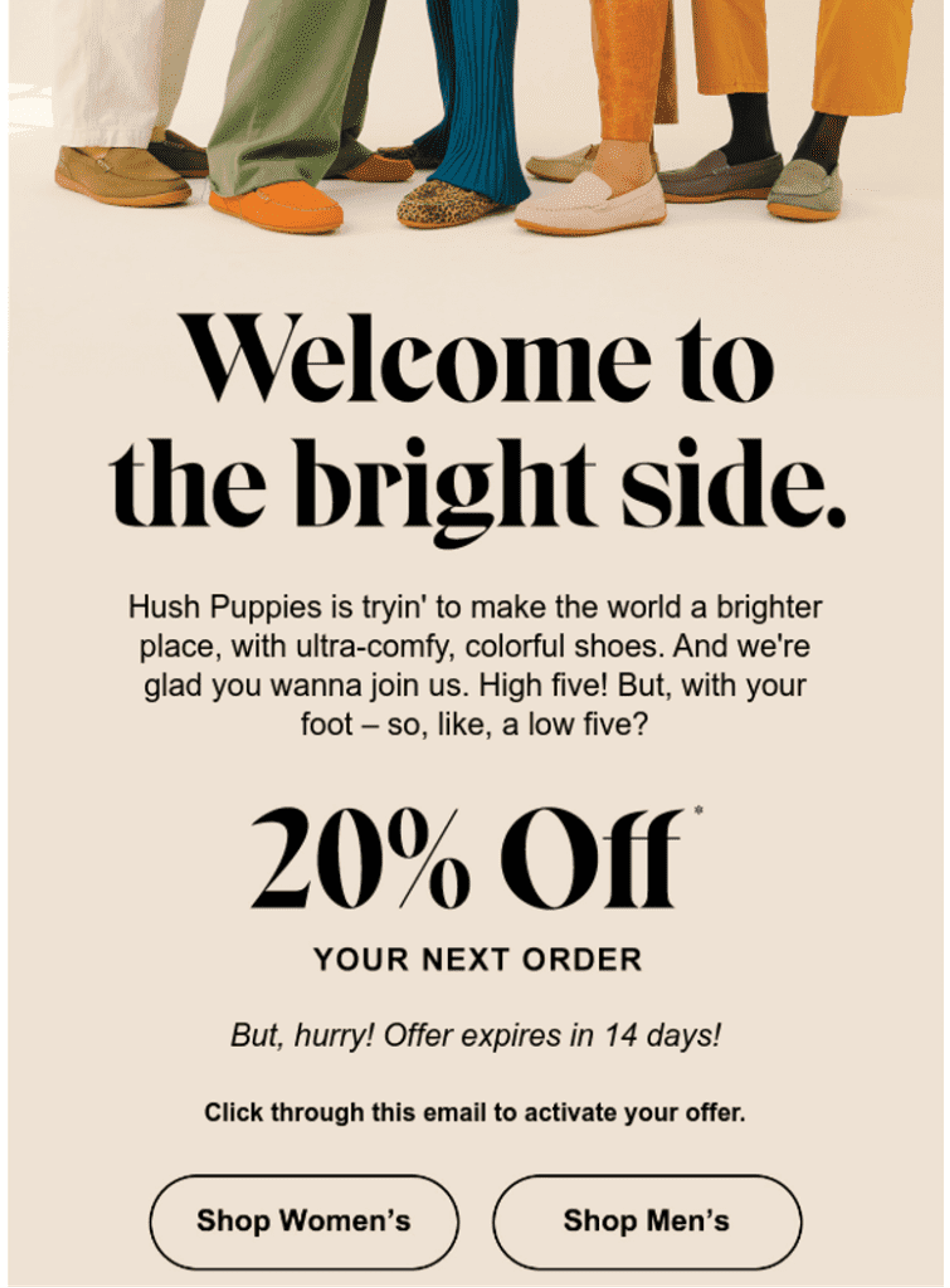
Hush Puppies’ welcome email is a prime example of how to use a good email design to get new customers to focus on what’s important.
The two take-home messages are “Welcome” and “20% Off,” which are made clear by the large and distinctive font.
The photo centered on just the shoes is another nice touch—Hush Puppies are slippers, what more do they need to show?
6. Urban Outfitters
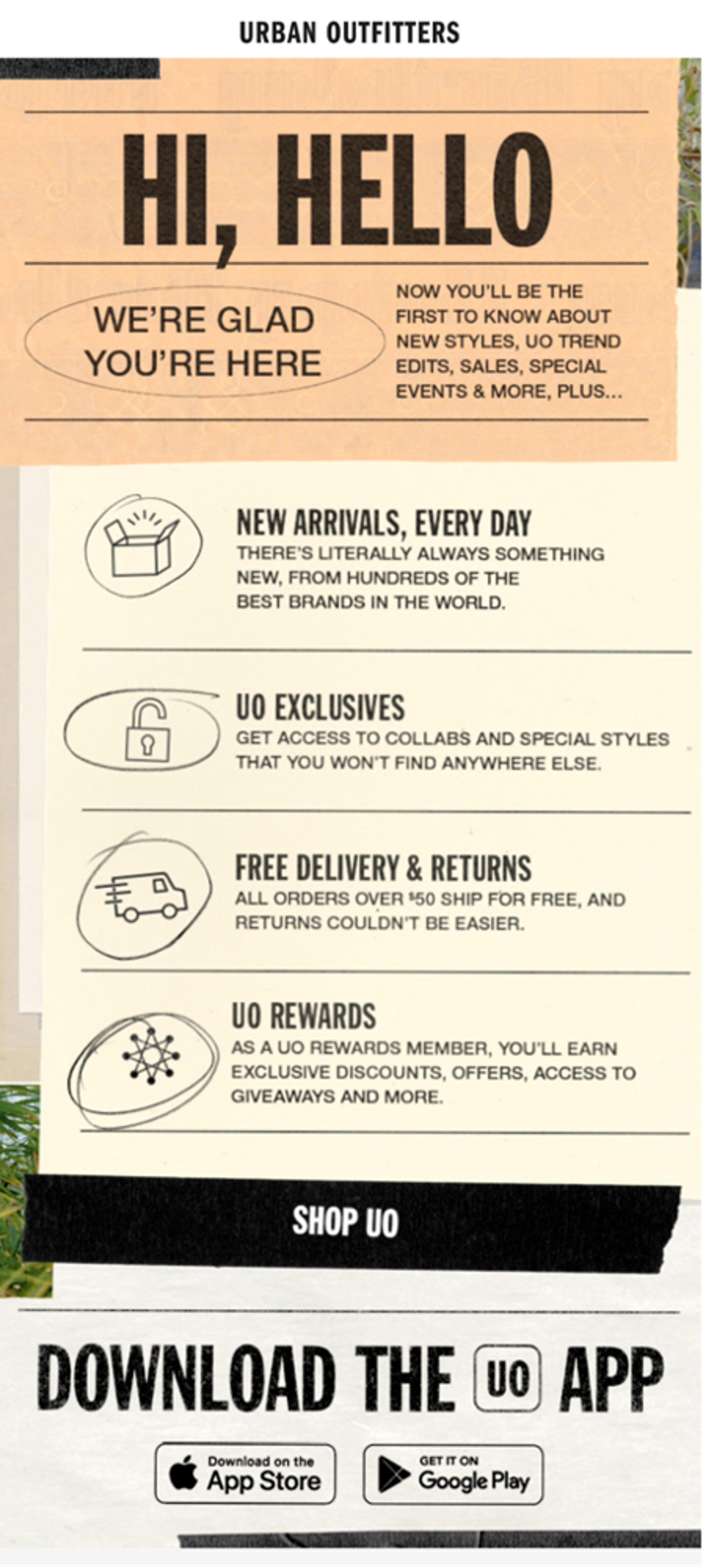
Urban Outfitters’ unique email design is not something you often find in your inbox.
There’s a great flow from how they welcome new subscribers to highlighting the benefits, and finally—promoting their app.
7. Lunya
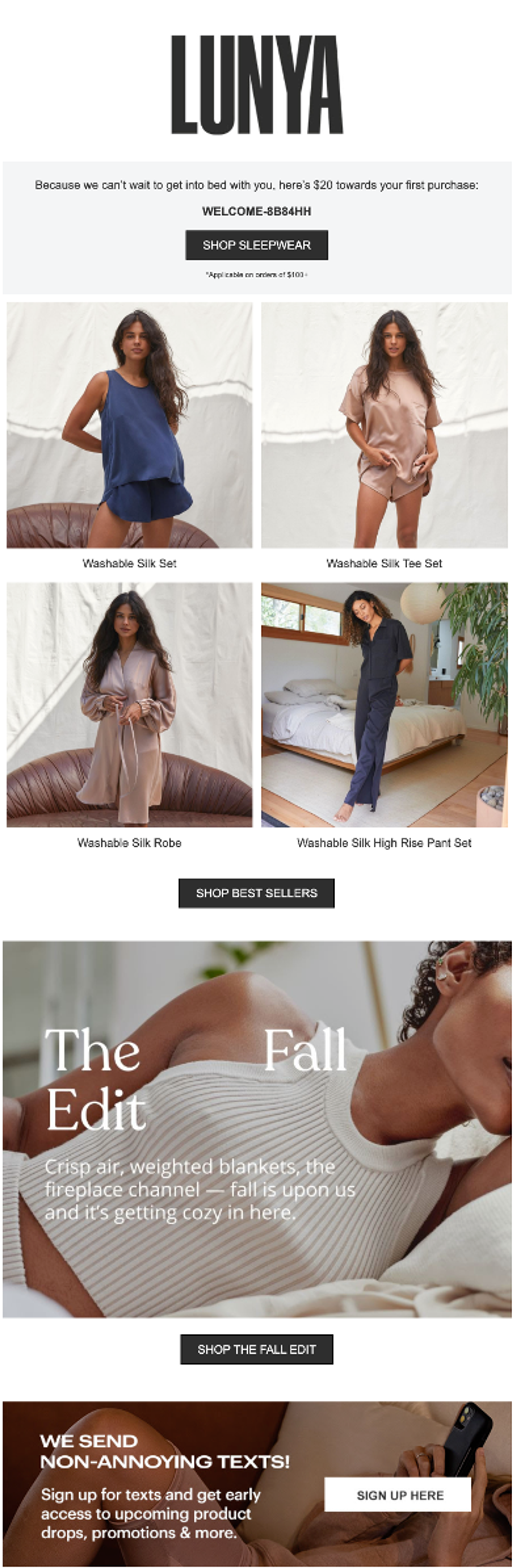
This welcome email example from Lunya succeeds at communicating a few different messages simultaneously.
The greatest emphasis is on their $20 off deal, but the company makes sure to include other information as well—like product recommendations or the option to sign up for texts.
8. Michaels
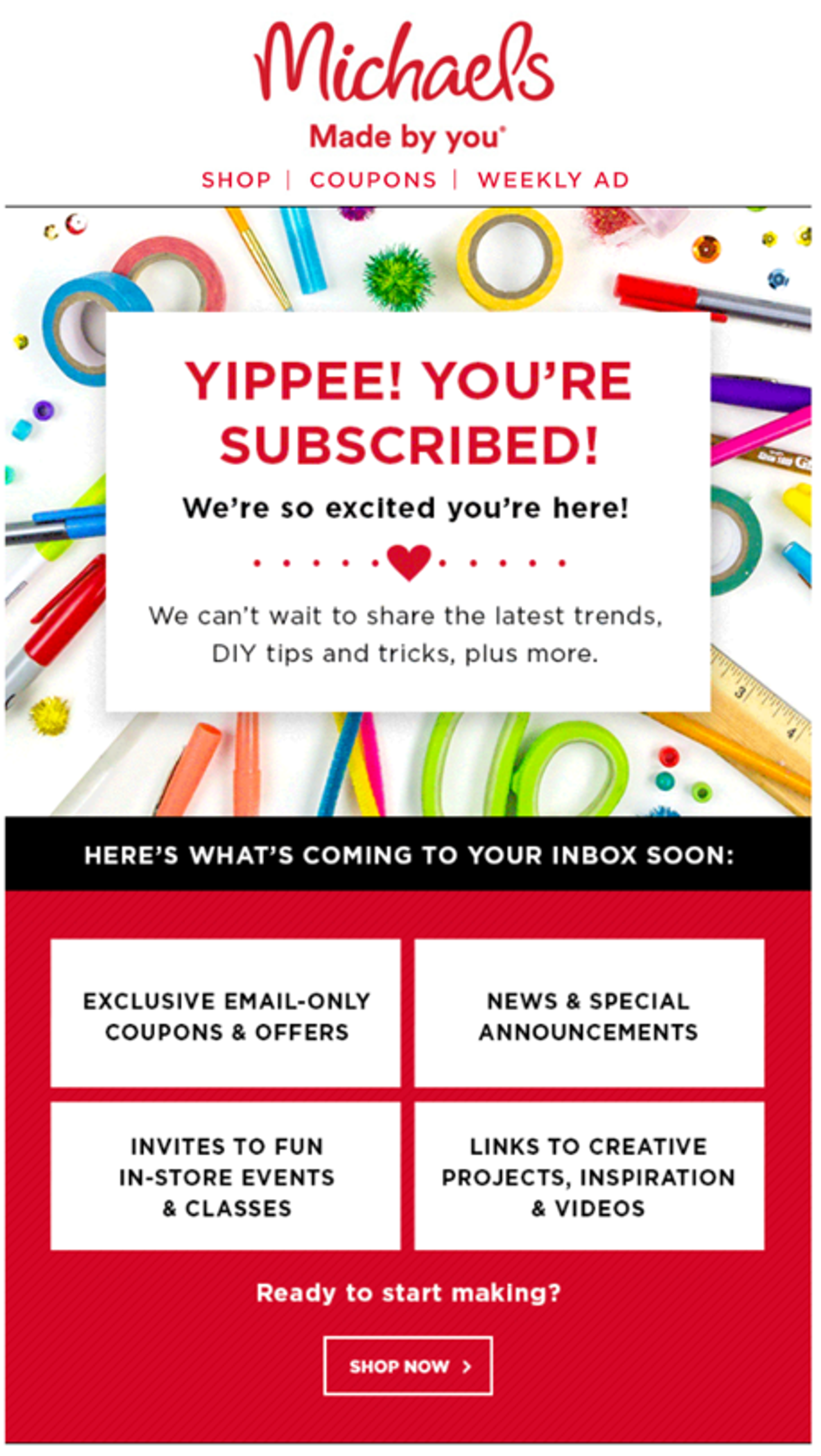
Michaels’ welcome email is exceedingly friendly and shows the excitement they feel about new subscribers. A few heart emojis can go a long way.
They also let you know what you can expect in your inbox in an easy-to-digest way.
9. Happy Box
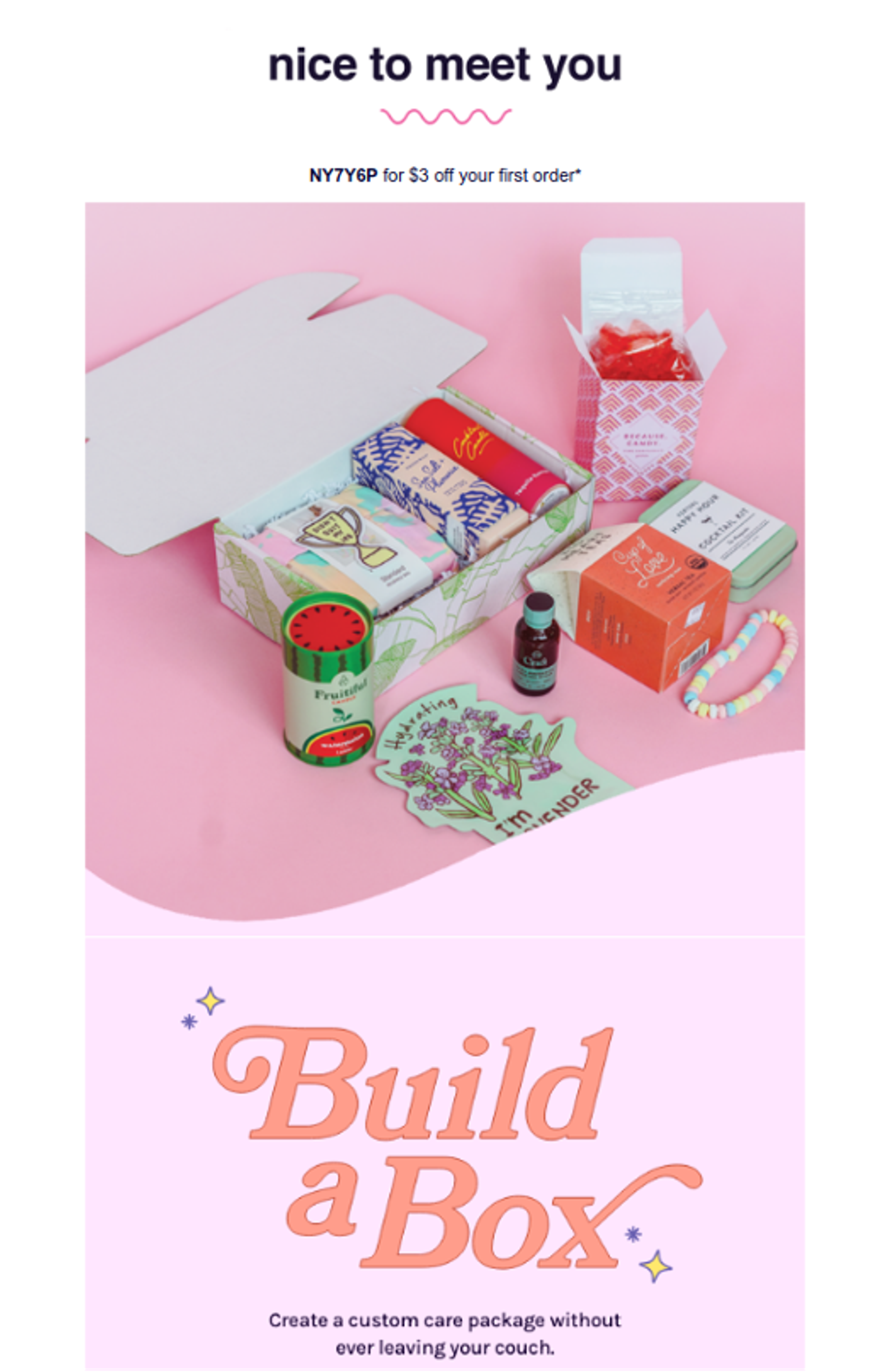
Check out how active this welcome email from Happy Box is. It invites email subscribers to “build a box” while making it seem like a fun and rewarding activity with the large image.
It also gives you an extra incentive with their $3 off coupon code right at the top of the email.
10. Taylor Stitch
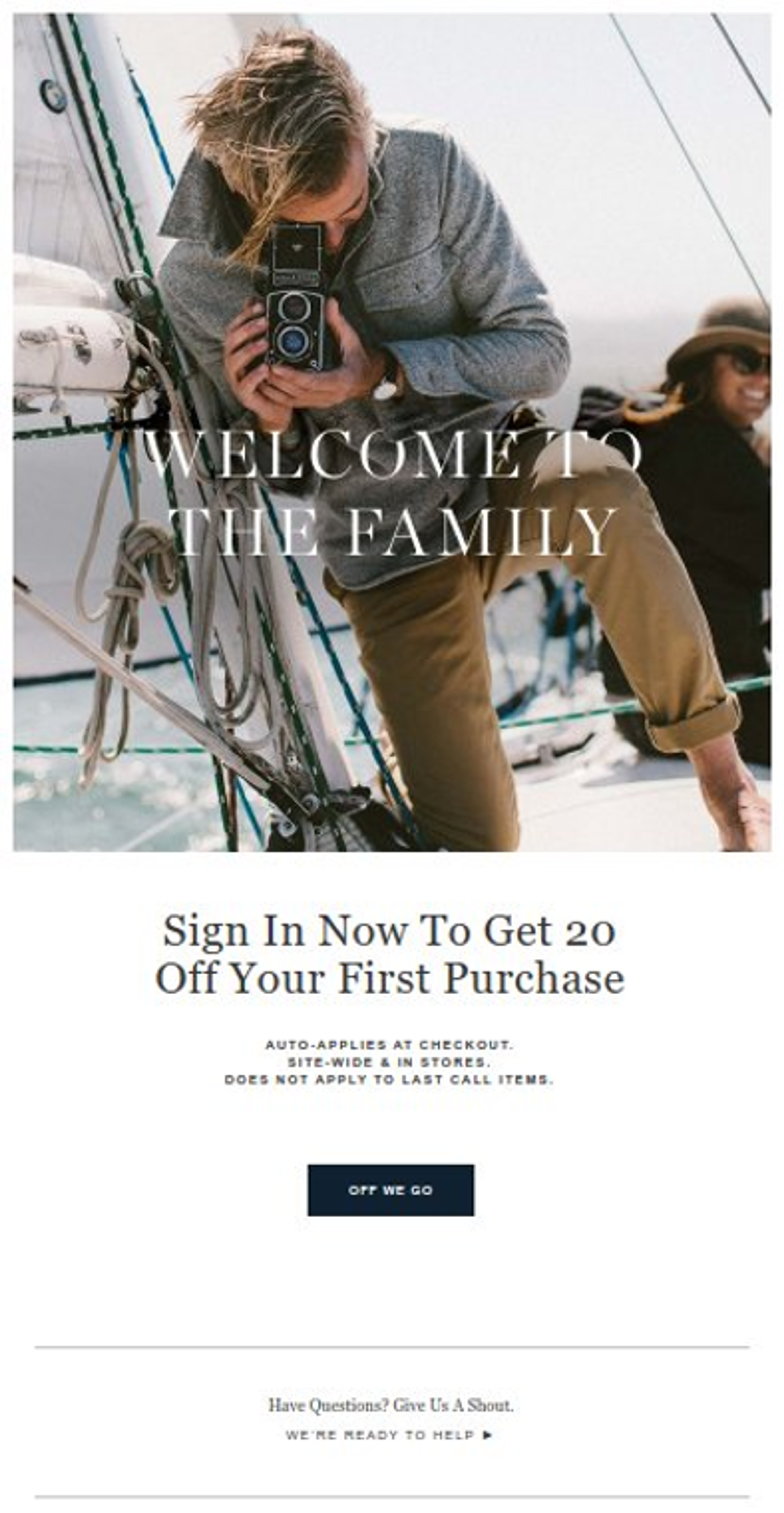
Taylor Stitch knows how to make a welcome email stand out. Here, everything stems from an exceptional photograph that reinforces the “Welcome to the Family” message.
It really seems like you’re out on that sailboat with a well-dressed relative taking a photo of you.
11. Lush
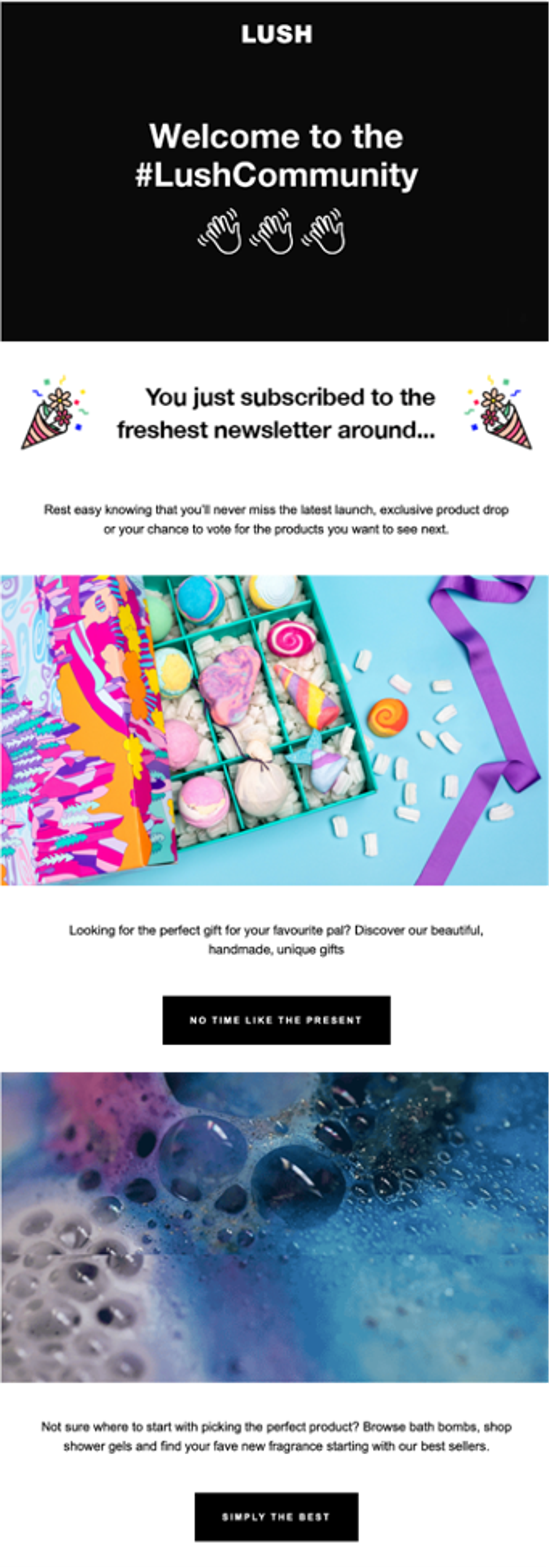
New subscribers are usually not that familiar with your brand yet, and they’re not sure which products are the best. Lush’s welcome email does a great job of suggesting where to get started.
12. Casper
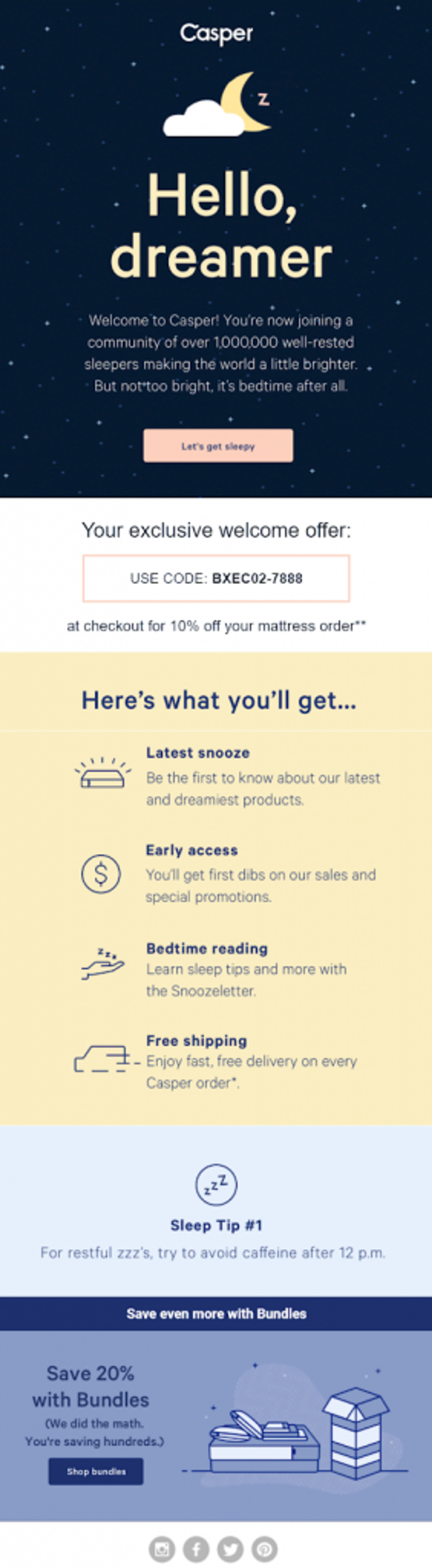
This message is a brilliant example of how to introduce your brand’s personality and build a sense of trust.
Beyond highlighting their satisfied customers (“1,000,000 well-rested sleepers”), Casper’s welcome email is clearly divided into separate sections (Introduction → Offer → Expectations → Tip → Offer) that move readers seamlessly through the message.
13. Arctic Fox
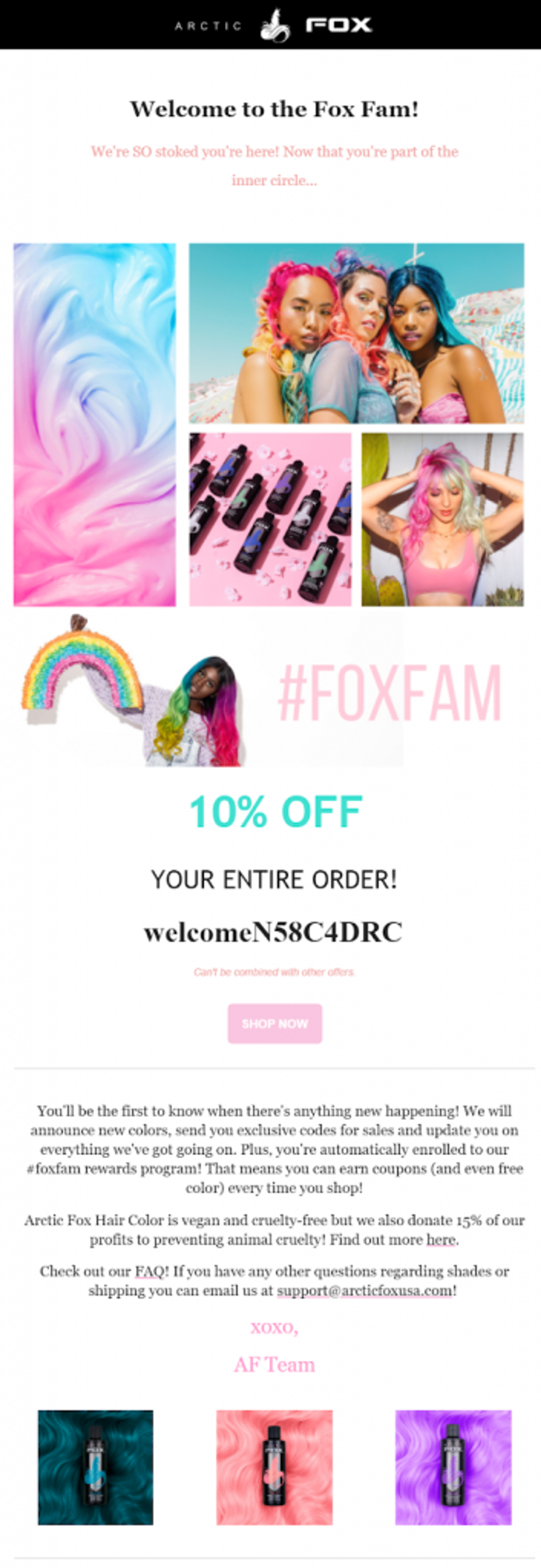
This message’s playful and conversational tone helps it stand out in a reader’s inbox. Meanwhile, the email provides multiple next steps for potential customers to take, including following Arctic Fox on social media, checking their products, or even redeeming a discount.
14. RXBAR
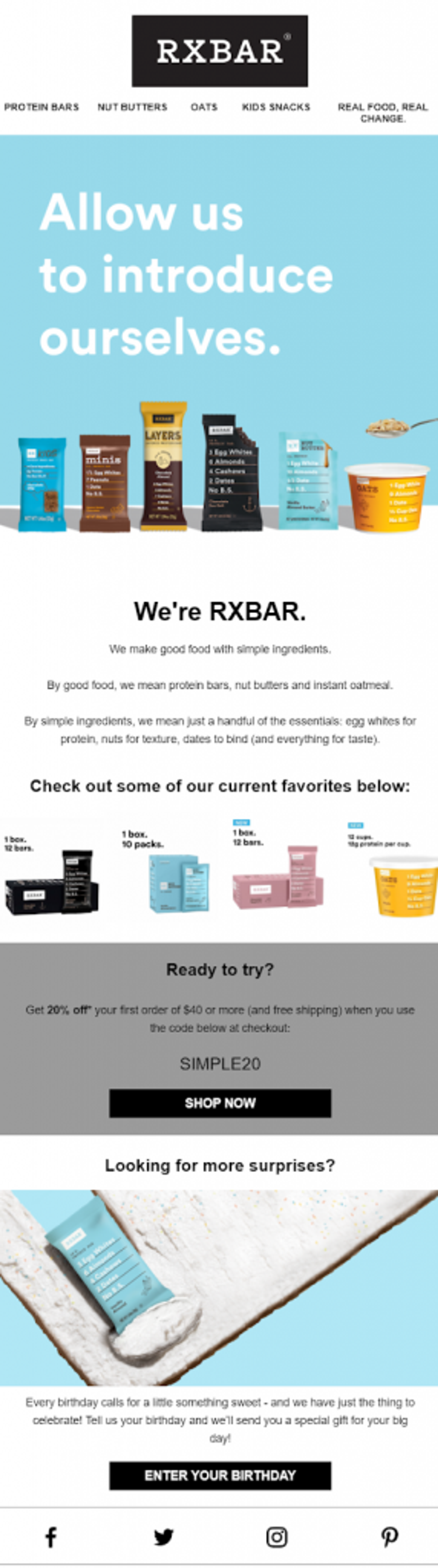
This is another example of how to organize a welcome email into separate sections and calls to action, all the while staying conversational with (mostly) single-sentence copy.
15. KonMari
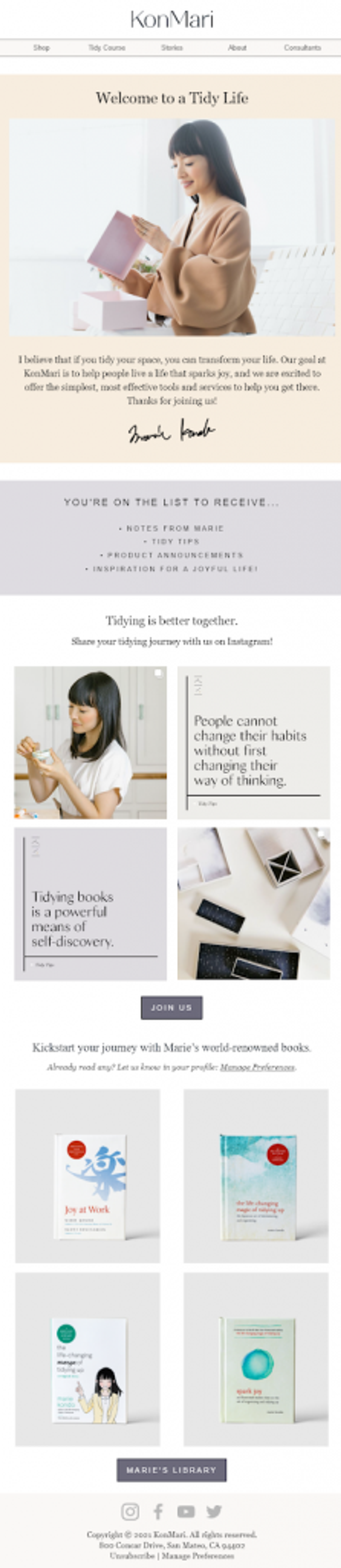
This message highlights how to put together longer welcome emails with multiple calls to action. The real-world pictures and the hand-written signature are both nice creative touches to make the email feel a bit more human.
16. Rifle Paper Co.
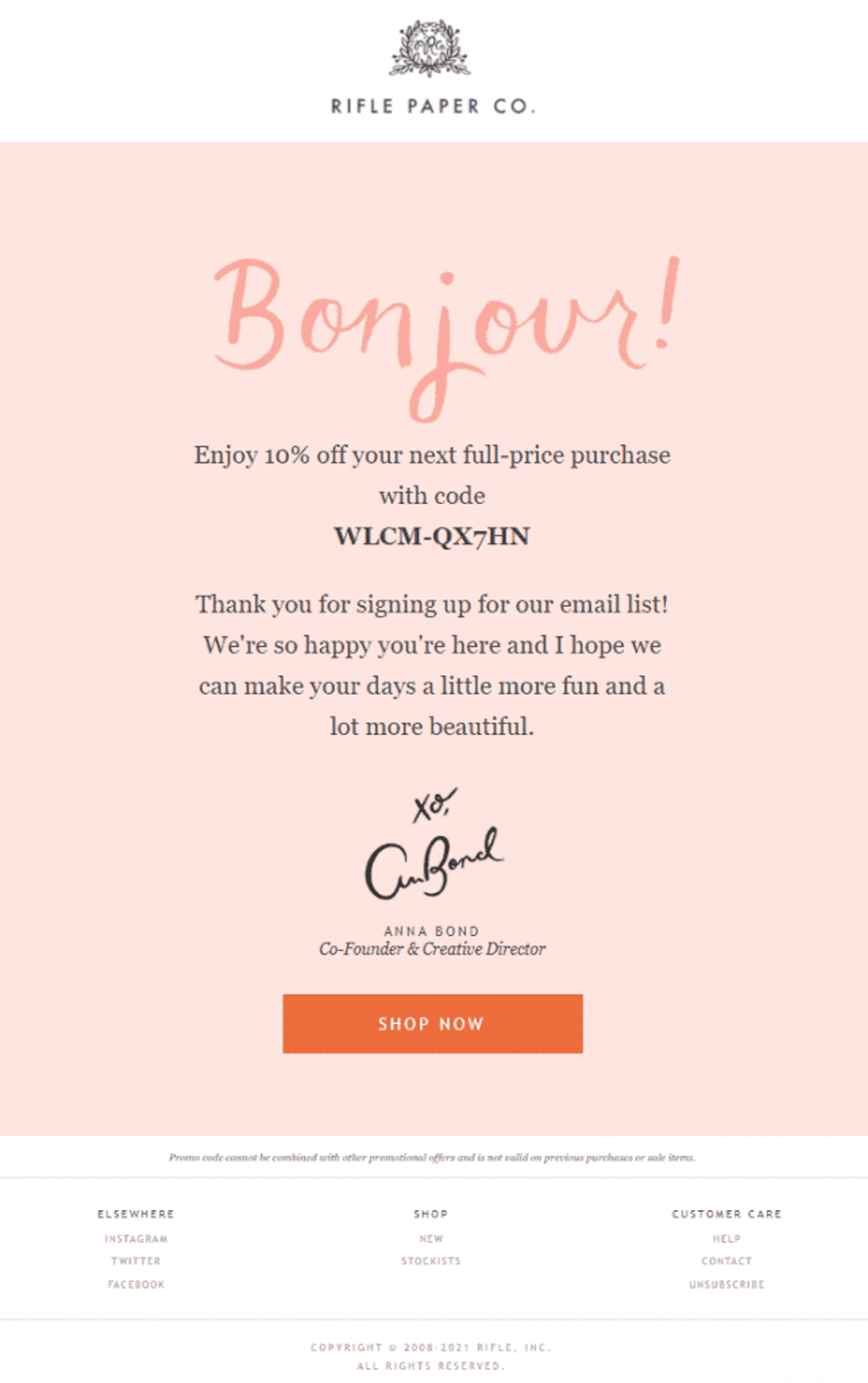
Finally, this is an example of how to craft a straightforward, no-frills welcome message that invites readers to buy while still being personable about it.
How to put together an effective welcome message?
Writing a welcome email can be daunting. Trust us, we get it. That’s why we recommend approaching your message piece-by-piece to make the process easier.
In this section, we’ll break down the anatomy of an effective ecommerce welcome message to help you write your own welcome email.
1. The subject line
Most people open emails based on the subject line alone. And welcome emails are no different. Most welcome email subject lines are a balance between being personable and highlighting an introductory offer.
For example, here are some welcome email subject line examples that address the recipient as “you” and don’t feel salesy at all. Instead, they present themselves as friendly invitations:
- “There you are! We’ve been waiting for you.” (Anthropologie)
- “You’re On The List (Great Things Are Coming!)” (AVON)
- “You’re in. Welcome to the family.” (Skullcandy)
And here are some deal-focused welcome email subject lines that manage to show off some personality:
- “Hello Gorgeous, Enjoy 10% Off!” (Arctic Fox)
- “10% off your dream mattress.” (Casper)
- “A very warm (10% off) welcome.” (Keds)
Recommended reading:The 140+ Best Email Subject Lines of All Time
2. The headline or preheader
The introductory text immediately following your welcome email subject line is almost as important as the subject line itself.
After all, this is the first sentence someone will see upon opening your message. If your recipient is looking at your welcome message via mobile, your headline is going to be front-and-center.
Don’t let this space go to waste. Instead, offer up an additional incentive, benefit, or personalized greeting to entice your readers. Below are some examples:
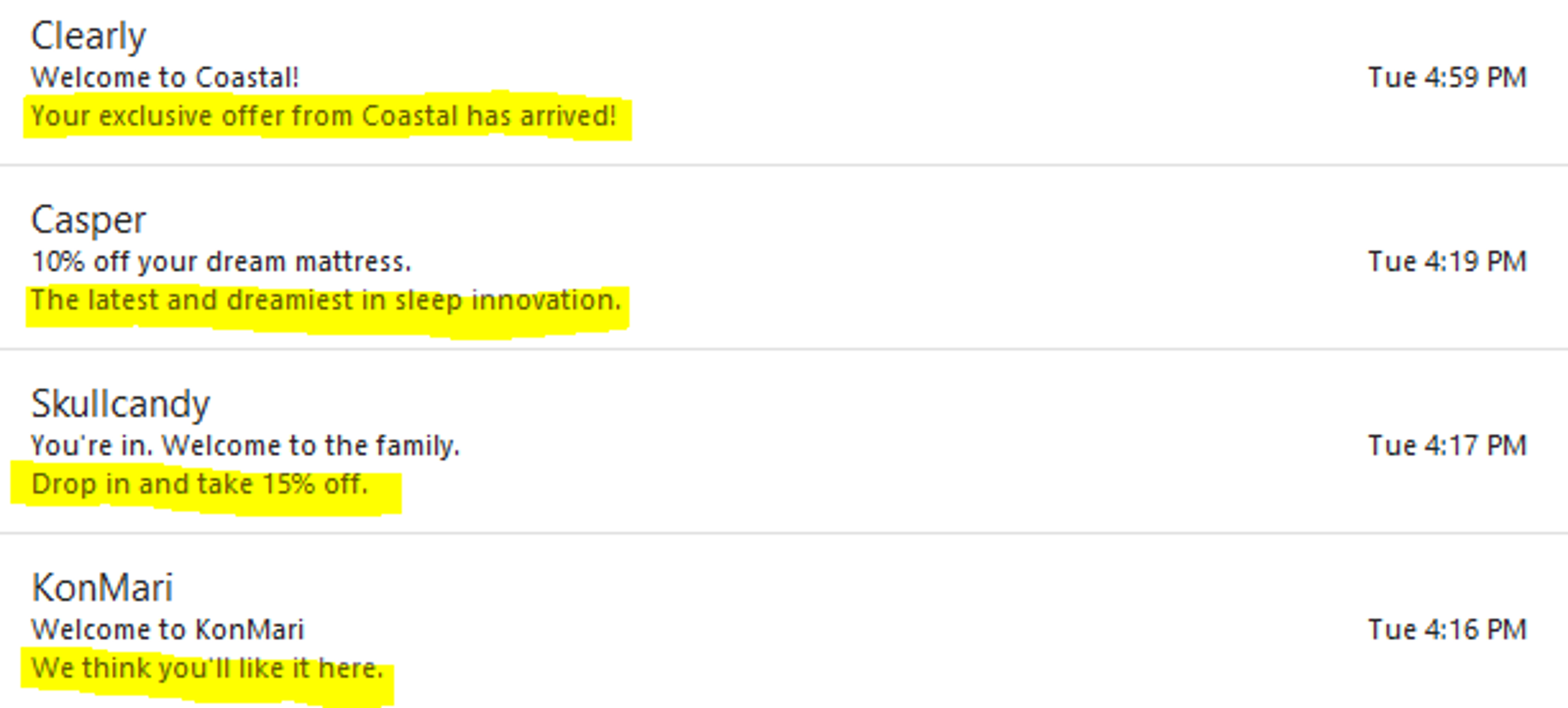
In short, let your headline act as a sort of one-two punch, to compliment your subject line in order to keep readers glued to your message. Get creative and try to say more than just “Welcome to our newsletter.”
3. The welcome email body copy
The good news about welcome emails is that you have a ton of freedom in terms of how you write them.
Want to keep them on the shorter side and stick mostly to bullet points? Looking to get wordy and tell your business story? Both options are totally fair game.
What’s most important is that you:
- Introduce your brand
- Outline expectations
- Invite readers to take some sort of action
Below is an example from AVON, clearly spelling out the benefits of being a subscriber with a punchy list that invites readers to start shopping.
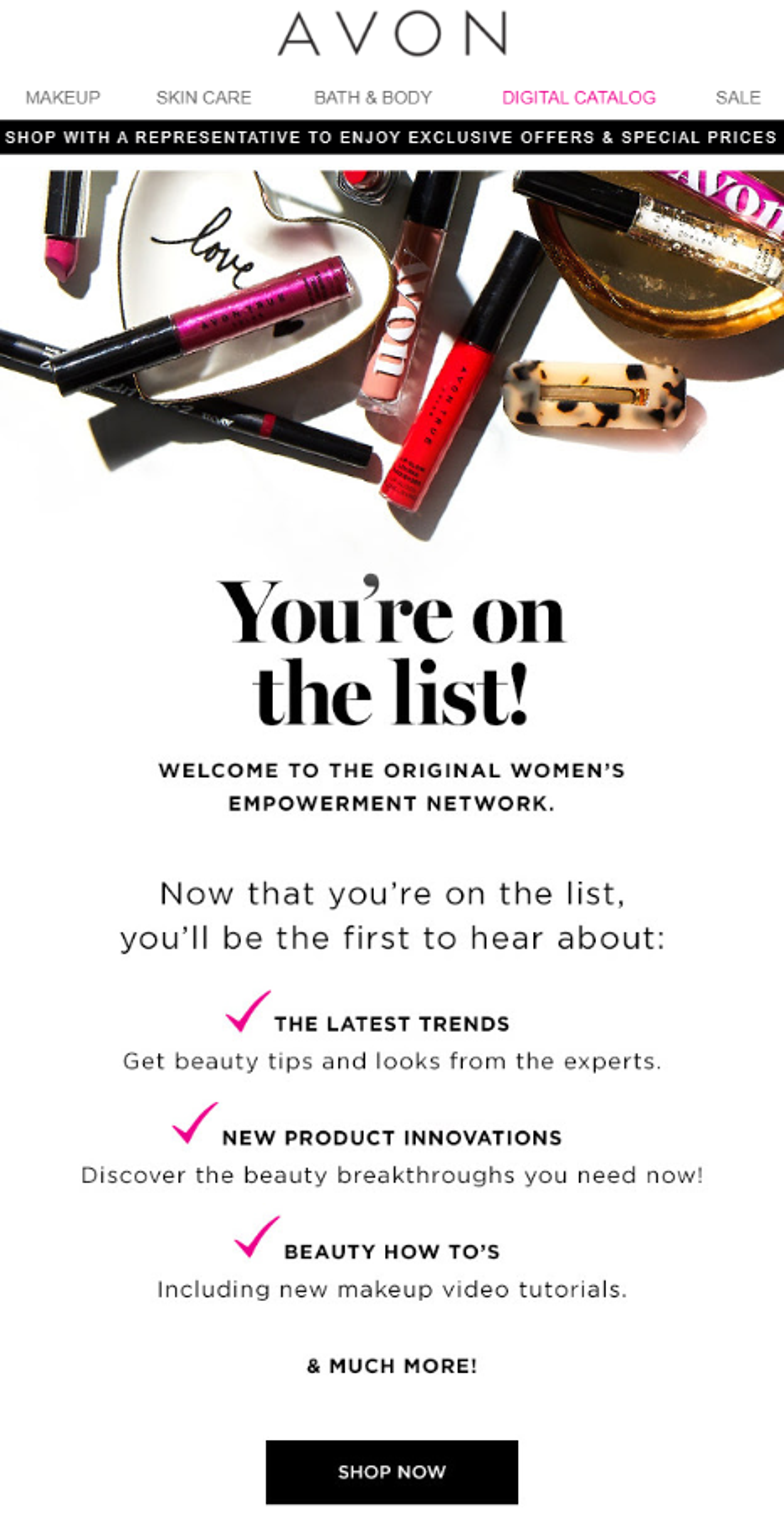
Don’t forget to talk to your new subscribers like they’re human. When in doubt, make a point to establish a conversational tone and reinforce how your business lends its customers a helping hand.
4. The call to action (CTA)
Remember what we said earlier about welcome emails having high engagement rates?
You need to give your readers something to click on or tap through upon opening. That’s where your calls to action (CTAs) come into play.
Below are some action items and call-to-action phase items to include in a welcome email (depending on your business):
- Check out a new product or redeem a coupon code (“Shop Now”)
- Follow your social media accounts for exclusives and updates (“Follow Us”)
- Read a relevant blog post or guide (“Learn More”)
Keep in mind that you can include multiple calls to action in a single email or keep the focus on a single action. Also, don’t be shy about selling in your welcome messages, if offers and discounts are why people signed up in the first place.
6 pro tips on writing welcome emails
Now it's time to check out 6 tips on how to write a welcome email. They can also be applied to all your marketing emails, but using them for welcome emails is of paramount importance.
Let's see those welcome email best practices!
Pro tip #1: Use colorful language
Throughout the entire welcome email, from your email subject line to farewell, a good copy should feature fun and approachable language.
You shouldn’t be engaging with new subscribers in a formal manner. This could feel cold and offsetting for the recipient. Instead, treat your welcome email as the first step in your new friendship.
Pro tip #2: Include eye-catching images
Text is important, but it would be a mistake to send a welcome email with just words. Images can be just as effective in accomplishing the goals of welcome emails.
For example, a well-chosen photo can help people come to an understanding of exactly what your online store is all about.
Email templates usually include many slots for images, so make sure to use them.
Pro tip #3: Great design on both mobile and desktop
Keep in mind that welcome messages will likely be viewed on both desktops and smartphones. This means that it’s important to design your welcome email for both devices.
If someone viewing your welcome email on mobile has to zoom and pan all over the place, you aren’t off to a great start.
Pro tip #4: Send the email immediately
Research has shown that 74% of people expect the welcome email to arrive immediately after they subscribe.
It’s particularly important to send your welcome emails quickly when they contain a discount code. Shoppers might already have a purchase in mind that they want to use the code for.
Pro tip #5: Choose your welcome email template carefully
You can find welcome email templates from many websites and email marketing providers. Free templates will often get the job done, but some online stores might want to spring for a custom welcome email template.
Whichever one you choose, make sure the template resonates with both your welcome message and your brand.
Pro tip #6: Keep it short
Nobody wants to spend 5 minutes (or more) reading the first email of your welcome series. Keeping it short shows respect for your customer’s time.
Wrapping up
Businesses can’t afford to ignore the importance of their welcome emails. Literally.
Because making a positive first impression is key to setting your subscribers up to become long-term customers. Sticking to the principles above can help you do exactly that.
Remember: winning those initial subscribers is the hard part. Once they’ve opted-in, you need to make sure you’re meeting their expectations.
Related articles
Written by

What should you do next?
Thanks for reading till the end. Here's how we can help you grow your business:
Get tailored website optimization ideas in 2 minutes.
Add your URL and get instant ideas. No email required.
Create a free OptiMonk account
Create a free OptiMonk account and easily get started with popups and conversion rate optimization.
Get OptiMonk free