
Your customer just paid. That's not the end of the sale, it's the best moment to make another one. Post-purchase upselling is one of the highest-converting, lowest-risk strategies in ecommerce: the original sale is already secured, buying intent is at its peak, and a well-timed offer takes a single click to accept. Here's how to do it right on Shopify: tactics, apps, and what actually works.
You did it. Your customer just hit the "Buy" button. Time to celebrate? Sure, but don't log off just yet.
Here's the thing: shoppers are still mentally in buying mode right after they complete a purchase.
That's the sweet spot, when their excitement is high, their wallet is open, and their trust in your brand is fresh. That's exactly where post-purchase upselling comes in: a way to grow revenue from customers who are already happy, already trusting you, and already in buying mode.
In this guide, we'll walk through why it works, four tactics you can implement today, and the top apps to help you do it, starting with how the whole thing actually works under the hood.
Why is post-purchase upselling important?
You’ve made the sale, but that’s just the beginning. Post-purchase upselling helps you turn a one-time customer into a high-value buyer, without extra friction or cost. Here's why it matters:
1. Increased revenue from each customer
It’s far more cost effective to increase revenue from existing customers than to acquire new ones. Post-purchase upsells let you boost average order value by offering relevant add-ons or upgrades when the customer is already in buying mode.
This means more revenue per transaction—with zero added acquisition cost.
2. Efficient use of momentum
The moment after checkout is powerful. Customers are still engaged, satisfied, and open to more. Post-purchase offers tap into that momentum before it fades, making it easier for them to say “yes” again—especially if they can do it with a single click.
Think of it as catching the wave instead of letting it crash.
3. Better personalization opportunities
Upselling and cross-selling after a purchase allows you to deliver highly targeted suggestions based on what the customer just bought. You can recommend complementary products, upgrades, or bundles that feel thoughtful, not pushy.
Personalized upsells feel like helpful advice, not a hard sell, and that keeps customers coming back, increasing their customer lifetime value over time.
4. Improved customer journey
Customers appreciate when you recommend products that genuinely complement their purchase. It shows you understand their needs, not just your sales goals.
For example, suggesting a phone case after someone buys a new phone is genuinely helpful. This thoughtful approach improves the overall customer experience and encourages repeat business.
5. Higher conversion rates
One of the biggest perks? More revenue from the traffic you already paid for. You're not investing in new ads or acquisition strategies, instead, you're increasing average order value by targeting customers at their most engaged moment.
It’s one of the most cost-effective ways to scale your revenue.
6. Easy to implement
Many ecommerce tactics require heavy lifting. Post-purchase upsells? Not so much. With user-friendly tools like OptiMonk, you can set up dynamic offers in minutes—no developer needed.
Most apps come with templates and drag-and-drop interfaces, so even first-time store owners can jump right in.
4 Shopify post-purchase upsell tactics that actually work
Alright, so you’re sold. Post-purchase upselling isn’t just a nice idea—it's a must if you want to maximize revenue from every customer who visits your Shopify store.
Let's break down some of the most effective Shopify-specific tactics you can start using right away, and build a solid upsell strategy from day one.
1. One-click upsell
This tactic is all about speed and convenience. One-click upsells appear right after checkout but before the customer lands on the thank-you page.
It's the golden in-between moment where they can add more to their order without re-entering payment info. Because friction is essentially zero, acceptance rates for well-targeted one-click offers typically range from 5–12%. Products that are frequently bought alongside the original purchase tend to convert best here.
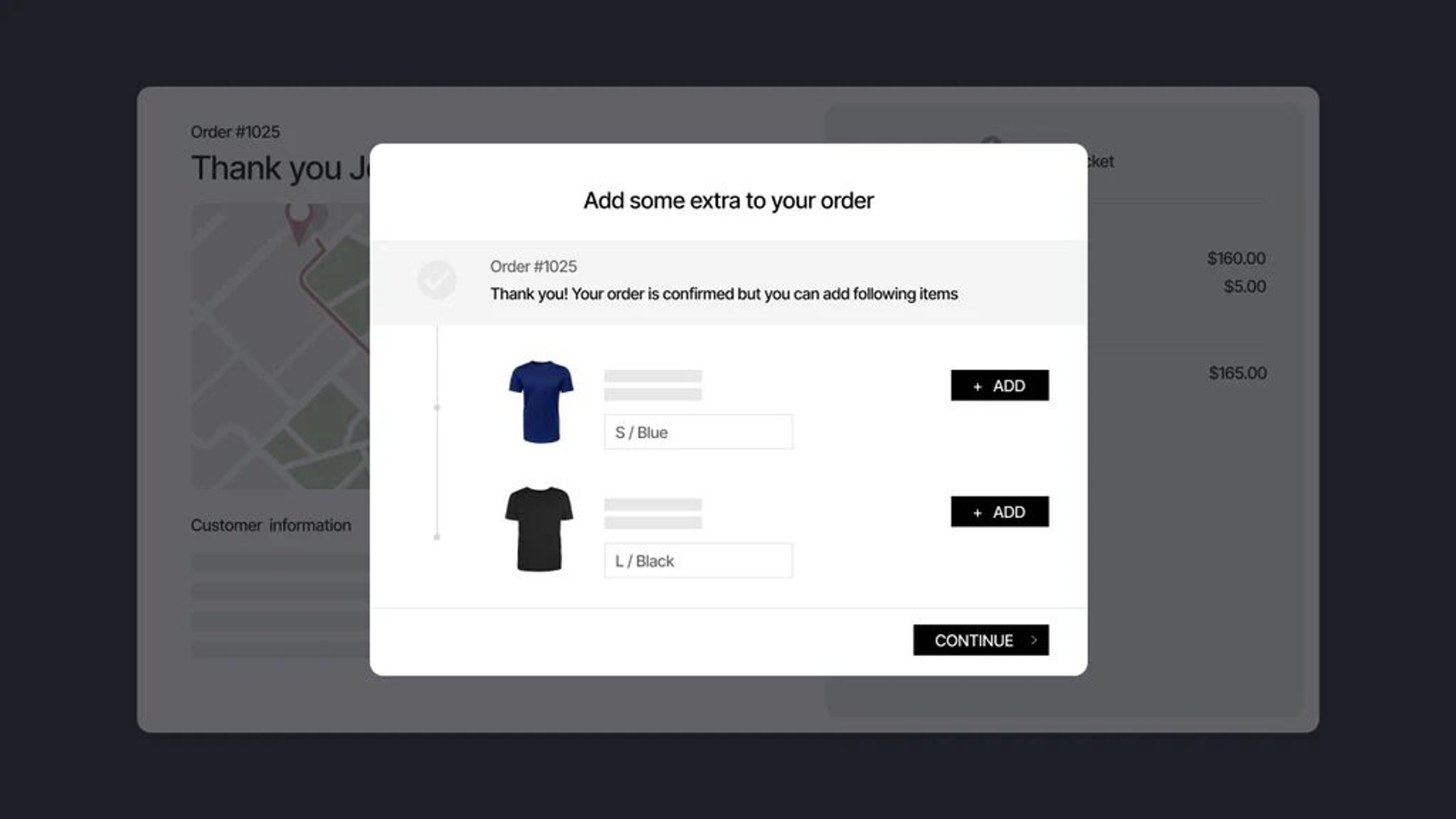
This example shows how easily you can add shirts to your order with a single click.
Source: Gempages
Pro tip: Avoid upselling products with high return rates. If an item gets returned frequently, it likely requires more research before buying, and a post-checkout impulse offer is the wrong moment for that conversation.
2. Upsell on the thank you page
Thank you page upsells are often underestimated. This page holds a customer's attention longer than most. They're scanning for order details, a shipping estimate, and confirmation that everything went through. That's a real window to place a second relevant offer.
Unlike a between-checkout offer, the thank-you page doesn't interrupt the flow at all. It works especially well for cross-sells, bundles, or subscription upgrades, and it's one of the easiest ways to elevate the overall post-purchase experience without any extra friction.
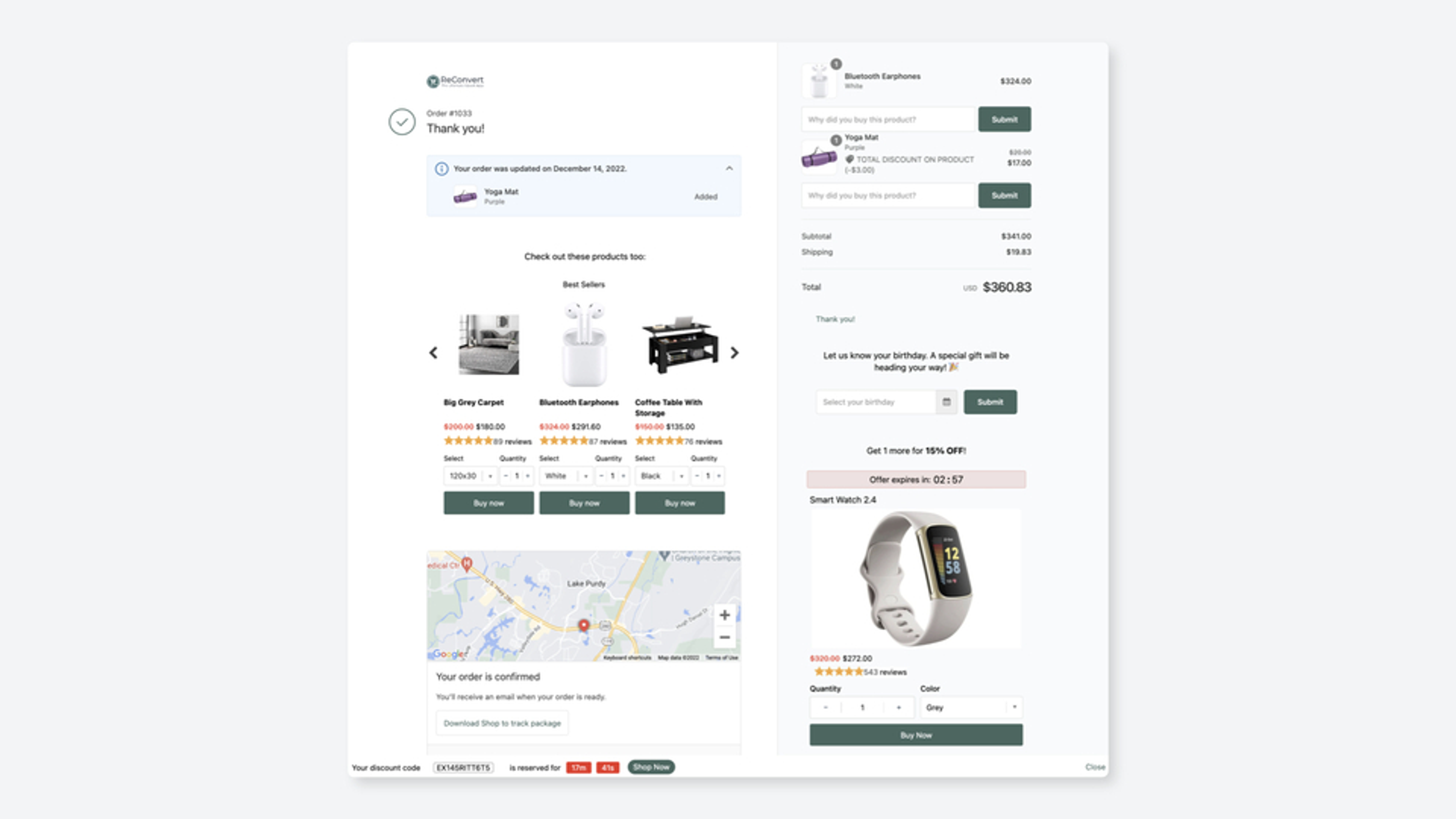
Here’s an example of using a thank-you page to promote a discounted product, which the customer can easily re-order with one click.
Source: Upsell.com
3. Use a post-checkout upsell popup
Popups often get a bad rep—but when used after the purchase, they can be surprisingly effective.
Triggering a well-timed post-purchase popup with a complementary product taps into the buyer's excitement. Feature bestsellers or add a time-sensitive discount to nudge the decision.
The most effective post-purchase popups are triggered by what the customer just bought, not shown to everyone. A personalized offer based on the specific product they purchased will always outperform a generic one, and messaging like "since you loved this, you might also like…" makes it feel like a natural continuation rather than a sales push. Keeping the design on-brand reinforces that feeling further.
Start using these popups today:
Pro tip: Include a star rating or a short customer review next to the upsell product. Social proof at this moment reassures the customer they're making a good addition, and that extra layer of trust can make the difference between a skip and a click.
4. Use post-purchase emails
The inbox is another powerful touchpoint for cross-sells. After the order is confirmed, you can send an automated email recommending complementary products, ideally within 24–48 hours.
Include a clear CTA and consider adding urgency with limited-time offers or “complete your set” incentives.
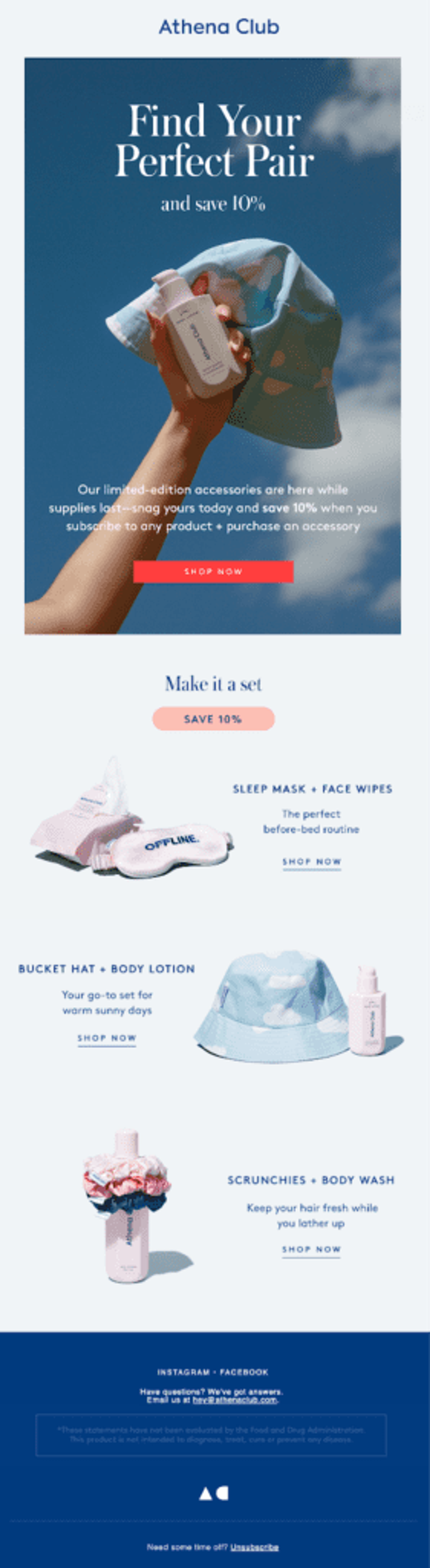
Athena Club sends beautifully designed emails that promote add-ons like razors or deodorant after a customer buys a subscription box. Smart, simple, and effective.
Source: Litmus.com
The best post-purchase upsell apps for Shopify
The right post-purchase upsell app does three things well: places the offer at the right moment, makes accepting it frictionless, and gives you enough targeting to keep offers relevant. Most offer a free plan or trial so you can test before committing.
Here are four of the strongest options on Shopify today.
1. OptiMonk
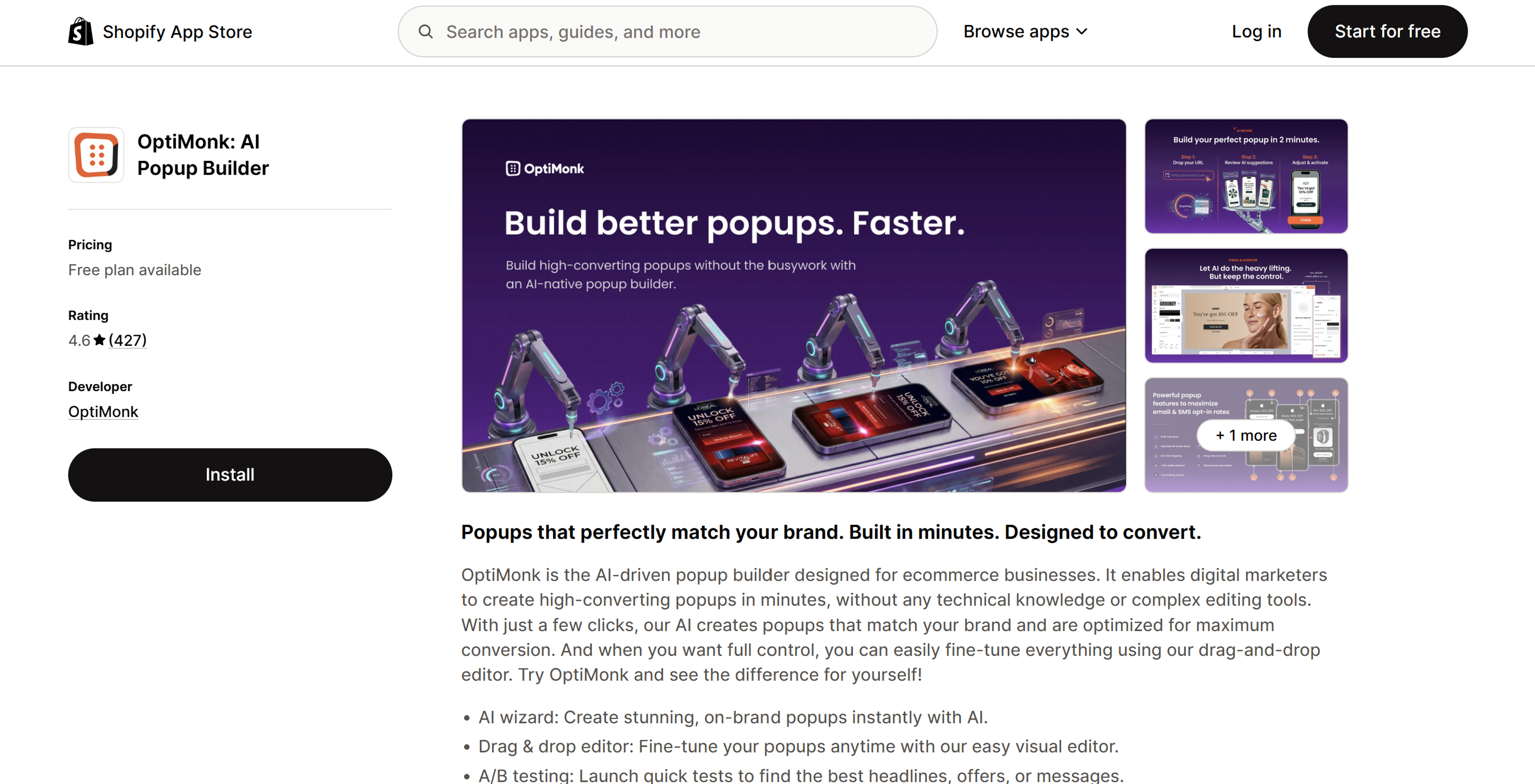
Shopify app store rating: 4.8
Pricing: Free plan available, then $29/month
OptiMonk approaches post-purchase upsell through popups and on-site messaging rather than dedicated funnel pages, which makes it the lightest-lift option for stores that want targeted offers after checkout without building a full upsell funnel.
For post-purchase specifically, the AI editor lets you describe the campaign you want in plain language and builds it for you—offer, design, and targeting rules—in minutes. Smart A/B testing then runs automatically in the background: different offer variants are tested, performance is tracked, and traffic shifts to the winning version without any manual intervention. Personalization works the same way, matching each popup to exactly what the customer just bought rather than showing a generic offer to everyone.
Best for: Stores that want AI-driven post-purchase popups that personalize, test, and optimize themselves. An all-in-one solution without the complexity of a dedicated upsell funnel builder.
Try OptiMonk on the Shopify App Store
2. Upsell.com (formerly ReConvert)
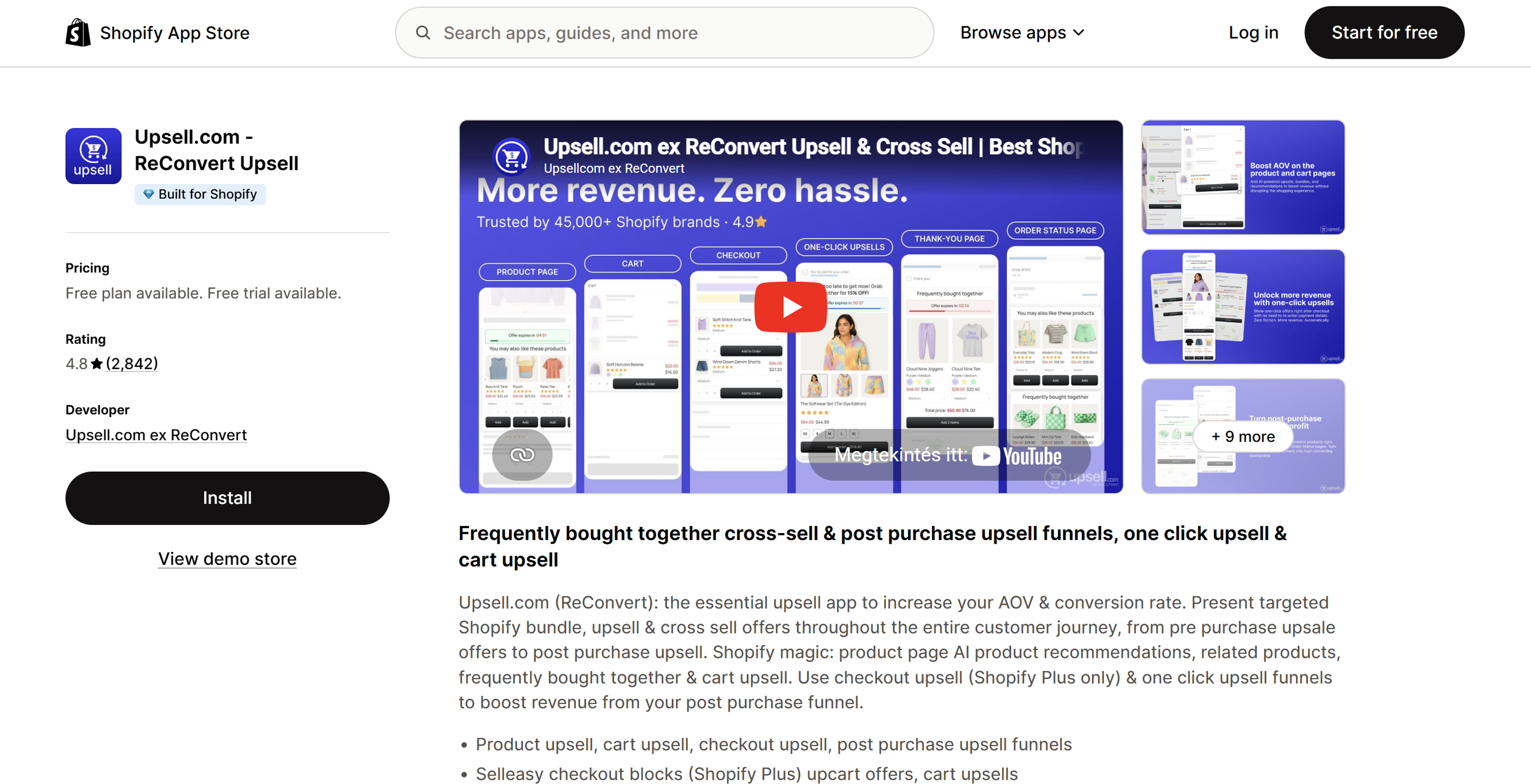
Shopify app store rating: 4.8
Pricing: Free plan from $4.99/month (scales by order volume and upsell revenue)
Upsell.com (formerly ReConvert) built its reputation on the thank you page upsell, and it remains one of the deepest tools for that specific moment. The drag-and-drop editor lets you add one-click upsell offers, countdown timers, product recommendations, and reorder widgets directly on the order confirmation page. Notably, thank-you page visitors return to that page an average of 2.2 times per order, which means your offer gets more than one impression per customer.
The app also covers one-click post-purchase offers between checkout and the thank-you page, with targeting based on cart contents, purchase history, and customer data. Built-in A/B testing and detailed analytics make it easy to craft a standout post-purchase experience and optimize over time.
Best for: Merchants who want to maximize the thank-you page as a dedicated upsell channel, with strong analytics to back their decisions.
Get Upsell.com on the Shopify App Store
3. Zipify OCU
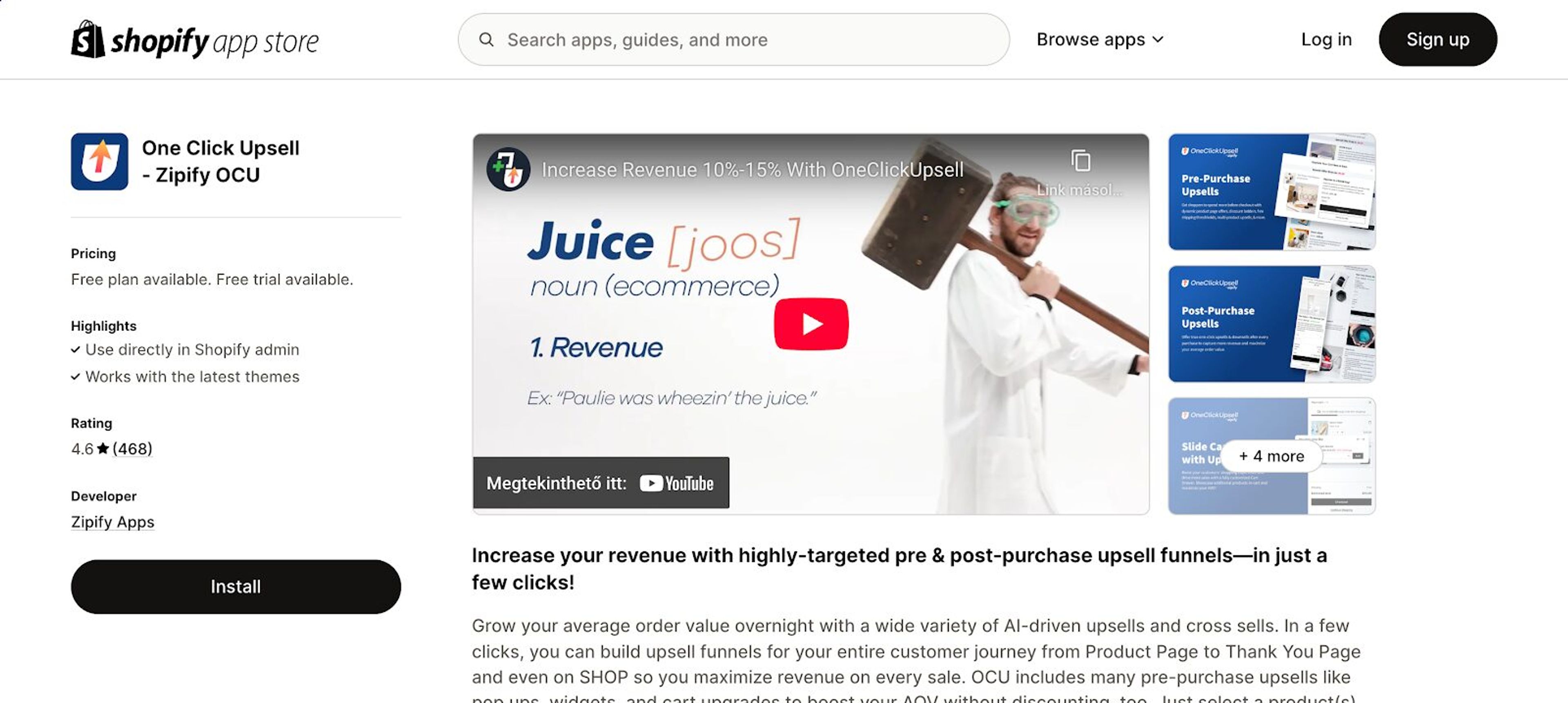
Shopify app store rating: 4.5
Pricing: 30-day free trial, paid plans from $35/month (revenue-based tiers)
Zipify OCU places its post-purchase offer in the highest-intent window of the entire checkout flow: after payment is confirmed but before the thank-you page loads. The AI picks the upsell product automatically based on what's in the order, and if the customer declines, a downsell fires immediately—a lower-priced alternative that gives you a second shot at revenue with no extra setup.
Pricing is performance-based: you only pay on the upsell revenue OCU generates, not on impressions or order volume. It's also the only upsell app with integration into Shopify's Shop app, extending your post-purchase offers beyond the browser.
Best for: Stores that want a fully automated upsell-to-downsell funnel between checkout and the thank-you page, with revenue-based pricing that scales with results.
Install Zipify OCU on the Shopify App Store
4. AfterSell
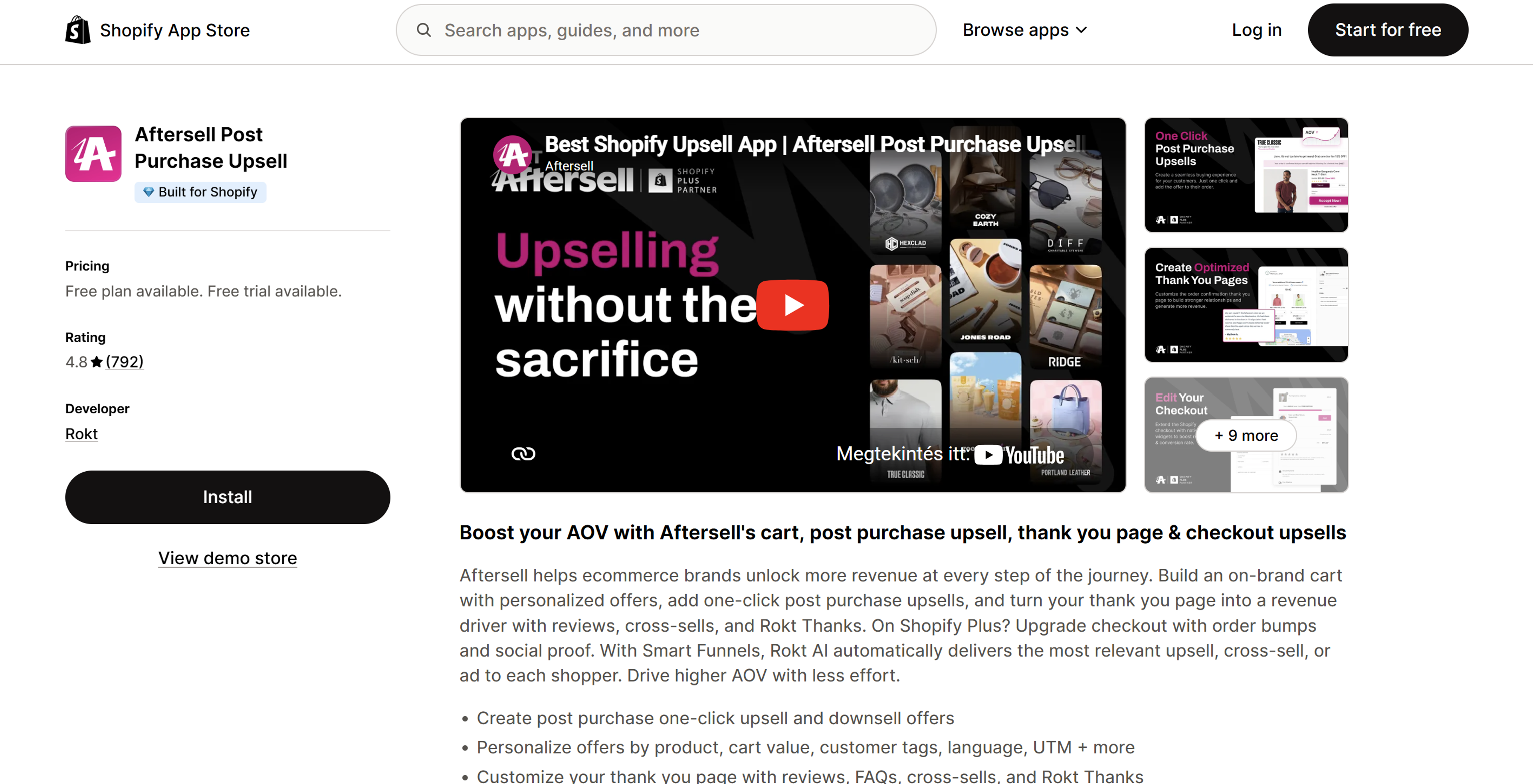
Shopify app store rating: 4.8
Pricing: 30-day free trial, from $34.99/month (scales by order volume)
AfterSell covers the full post-purchase experience: the moment after payment, the thank-you page, and for Shopify Plus stores, the checkout page itself. Its standout feature is the Rokt Brain, an AI targeting engine that matches each shopper with the offer they're most likely to accept in real time, based on cart contents, UTM source, customer tags, language, and lifetime order value.
That means a first-time buyer and a returning VIP can see completely different offers without any manual segmentation. Everything is built in a no-code editor, and the advanced A/B testing suite lets you run thousands of test variations to find the highest-converting upsell strategy for your Shopify store.
Best for: Growing stores that need granular AI-driven targeting across multiple customer segments, with Shopify Plus unlocking checkout-level upsells.
Download AfterSell from the Shopify App Store
What to look for in a post-purchase upsell app
Not all upsell apps are built the same. Before picking one, run it against these criteria, and always check whether a free plan or trial is available so you can test your upsell strategy before committing:
- One-click functionality. Customers should be able to accept an offer without re-entering payment or shipping details. Any extra step here will tank your acceptance rate.
- Targeting and personalization. Generic offers convert poorly. The more tailored the offer — based on purchase history, cart value, or customer segment — the higher your conversion rate. Look for apps that let you build these rules without needing a developer.
- Mobile optimization. A large share of Shopify purchases happen on mobile. Your upsell page needs to load fast and be easy to interact with on a small screen.
- A/B testing. Your first offer won't be your best one. Stores that combine built-in split testing with smart targeting see significant lifts in average order value over time — because every iteration is driven by real data rather than guesswork.
- Analytics and reporting. You can't improve what you don't measure. Look for apps with a clear dashboard that tracks key metrics like conversion rates, average order value lift, and total upsell revenue, so you always know what's working and where to optimize next.
Comparing the top post-purchase upsell apps for Shopify
The right app depends on what you're trying to solve.
If you want a lightweight popup-based approach with a full CRO toolkit, OptiMonk is the natural fit. If you need a dedicated upsell funnel with downsells and advanced AI targeting, AfterSell or Zipify OCU are worth the higher price point. Upsell.com sits in the middle, strong on the thank-you page, accessible pricing, and a solid feature set for stores of any size.
| App | Rating | Starting price | Best post-purchase use | Other notable uses |
|---|---|---|---|---|
| OptiMonk | 4.8 | Free / $29/mo | AI-driven post-checkout popups | Exit-intent, cart abandonment, email capture, surveys, CRO |
| Upsell.com | 4.8 | $4.99/mo | Thank-you page & one-click upsells | Product page upsells, cart upsells, order status page offers |
| Zipify OCU | 4.5 | $35/mo | Upsell-to-downsell funnel | Pre-purchase funnels, cart drawer, Shop app offers |
| AfterSell | 4.8 | $34.99/mo | AI-targeted post-purchase offers | Checkout upsells (Plus), cart, order confirmation monetization |
Wrapping up
Post-purchase upselling is one of the simplest ways to increase your average order value and build stronger customer relationships, and a well-executed upsell strategy does it without spending a dime on extra ads.
Whether you go with a one-click upsell between checkout and the confirmation page, a thank you page upsell, a post-purchase popup, or a follow-up email, the two things that determine success are always the same: timing and relevance.
Nail those two, and you'll turn a single sale into a longer, more valuable relationship. Want to maximize revenue from every customer who walks through your door? Start today by creating a free OptiMonk account.
FAQ
How does post-purchase upselling actually work on Shopify?
Here's the flow: the customer clicks "Pay now" and completes their order. Payment is confirmed. Then, before they reach the thank-you page, a targeted offer appears. They can accept it with a single click, no re-entering card details, no second checkout. The item is added to their existing order and charged to the same payment method automatically. If they decline, they land on the thank-you page as normal. Either way, the initial transaction is never at risk.
What's the difference between a post-purchase upsell and a pre-purchase upsell?
The difference is timing and risk. A pre-purchase upsell appears before checkout and always carries some risk of distracting a customer into abandoning their cart. A post-purchase upsell appears after the payment is confirmed, so the initial purchase is already locked in. There's no abandonment risk, and the numbers back it up: post-purchase offers convert 10% to 30% higher than pre-purchase ones, precisely because the buying decision has already been made.
Won’t post-purchase upselling annoy my customers?
Not if you do it right. The key is relevance. Customers don’t mind being offered something that adds value to their original purchase—especially if it’s presented in a non-pushy way. Offering a compatible item (like a protective case after a phone purchase) actually feels helpful.
In fact, many customers appreciate the convenience of completing their setup in one go. Just avoid throwing in unrelated or generic products—they come off as desperate and can hurt your brand trust.
Can I upsell on mobile, too?
Absolutely, and you should. Mobile shoppers make up a large portion of ecommerce traffic, and most modern post-purchase upsell apps are fully optimized for mobile. Whether it's a one-click upsell, a post-purchase popup, or a customized thank-you page, these experiences are designed to look and function smoothly across all screen sizes.
Can upselling help with customer retention, not just revenue?
Yes, and it often does. When upselling is done thoughtfully, it enhances the overall customer experience. That positive impression increases the likelihood of repeat purchases and grows customer lifetime value over time. If a customer buys skincare and you upsell a complementary item that genuinely improves results, they're more likely to come back for refills and future orders.
What is a downsell, and should I use one?
A downsell is a follow-up offer shown when a customer declines your primary upsell. Instead of going straight to the thank-you page, they see a lower-priced or simpler alternative. It's a way to recover revenue from customers who weren't ready to commit to the first offer. If you have a natural lower-tier product that complements the original purchase, it's worth testing.
What's the difference between upsells and cross-sells?
An upsell encourages a customer to buy a higher-end or larger version of what they just purchased. A cross-sell suggests a different but complementary product.
Example:
- Upsell: Upgrade to a premium coffee machine.
- Cross-sell: Add coffee pods or a mug.
Both increase average order value and both work well post-purchase, the right choice depends on your product catalog.
What's a realistic conversion rate for post-purchase upsells?
For well-targeted offers, a conversion rate between 10–20% is achievable. One-click upsells placed between checkout and the thank-you page tend to convert higher than thank-you page offers, simply because the buying momentum is fresher at that moment. A good baseline to aim for when starting out is 5–10%.
How do I know which product to offer as an upsell?
Start with your store data. Look at which products are frequently bought together. Those pairings are your natural first candidates. Complementary items work best: a case with a phone, a filter with a coffee machine, a matching conditioner with a shampoo. The upsell item should feel like an obvious next step, not an afterthought. Avoid offering the exact same product unless it's a consumable where buying more makes clear sense. The more obvious the logical connection, the higher your acceptance rate.
Related articles
Written by

What should you do next?
Thanks for reading till the end. Here's how we can help you grow your business:
Get tailored website optimization ideas in 2 minutes.
Add your URL and get instant ideas. No email required.
Create a free OptiMonk account
Create a free OptiMonk account and easily get started with popups and conversion rate optimization.
Get OptiMonk free