How Often Should You Send Marketing Emails? A Simple Guide for Email Marketing Frequency
Learn about email marketing frequency for ecommerce stores. Most send 1-3 emails per week, with frequency adjusted by subscriber engagement and store type.
Discover 50+ email marketing statistics for 2026 that prove email is still the king of ROI, engagement, and conversions.
In short
Email marketing remains a powerful tool in 2026, with 4.6 billion users and a strong ROI of $36 for every $1 spent. Key statistics reveal that segmentation and AI-driven personalization significantly boost engagement, while automated emails outperform manual ones. Optimize for mobile and leverage popups to enhance list-building efforts, ensuring your email strategy stays ahead in the digital marketing landscape.
Let’s be real: email isn’t going anywhere. If anything, it’s aging like fine wine. Sure, social media and SMS are shiny distractions, but the numbers? They tell a much different story.
Still wondering if email marketing is worth the investment in 2026? Spoiler alert: it absolutely is.
We’ve rounded up 50+ latest email marketing statistics that not only prove email marketing is alive and kicking but also highlight the power of well-crafted email campaigns tailored to your target audience.
Whether you're aiming to increase ROI, boost engagement, or fine-tune your automation, these insights will give you a serious edge as you head into 2026.
Here’s what you’ll learn:
Ready? Let’s jump in.
Email isn’t just alive, it’s thriving.
Why does this matter?
Because the email inbox is still one of the most direct, personal channels for reaching your audience.
Constantly.
The takeaway? Your email has plenty of opportunities to get seen, especially if you send it at the right time and with the right message.
Most emails today are opened on smartphones, 50–70% or more, depending on the source.
That makes mobile the top platform for email engagement among email users.
And with that comes a clear message: if your emails aren’t optimized for small screens, you’re falling behind. You should design mobile-first:clean layouts, tappable buttons, and fast-loading images are must-haves.
Younger audiences are leading the charge. People aged 18–34 tend to check emails almost exclusively on their phones, so if your target audience falls into that age, mobile-first is a must for you.
Another interesting statistic: Apple devices dominate mobile opens.iPhones are still the go-to for checking email.
But don’t overlook cross-device habits.
Just because someone opens your email marketing campaigns on a mobile device doesn’t mean they’ll interact with it right away.
Let’s dig into the numbers that show how email is really performing and where the biggest opportunities lie.
Let’s start with the basics. The average email sees:
These engagement rates provide a useful benchmark as they show what’s considered “typical” across most industries.
If your goal is to stand out and drive real results, you’ll need to move beyond the basics and start leveraging more advanced tactics.
That’s where automated and triggered emails come into play, and the numbers speak for themselves:
It’s clear: automation isn’t just helpful, it’s a game-changer. And when it’s paired with behavior-based triggers, the impact is even greater.
Why does it work so well? These emails are sent at precisely the right moment, based on user actions like browsing a product, abandoning a cart, or making a purchase.
They're highly relevant, personalized, and timely, three things that naturally lead to higher engagement and more conversions.
Using the right email marketing software can make setting up these automated campaigns easier and more effective.
Let’s take a closer look at how email performance stacks up across different industries. These benchmarks give valuable insight into what you can realistically aim for, depending on your niche.
Here’s how average open and click-through rates compare by sector:
| Industry | Avg open rate | Avg CTR |
|---|---|---|
| Non-profit | 53.21% | Content |
| Health & Fitness | 48.9% | ~1.74% |
| Consulting | 45.74% | 2.66% - 3.25% |
| Education | 45.32% | 2.26% - 4.4% |
| Politics | 44.83% | ~4.28% |
| Entertainment | 43.79% | ~3.37% |
| Financial | 43.26% | ~1.79% |
| Marketing | 39.05% | Data varied, around 1.8-2% |
| Software/IT | 38.14% | 1.91% |
| Retail | 37.5–38.58% | 1.19% - 1.34% |
| Recruitment | 32.7% | ~3.02% |
| Manufacturing | 32.65% | ~4.29% |
When it comes to marketing channels that consistently deliver results, email remains one of the most profitable, and the stats back it up.
The average return on investment for email marketing is a whopping $36 for every $1 spent.
That puts it among the top-performing digital marketing channels, often outpacing paid ads, SEO, and social media when it comes to cost-efficiency.
Whether you’re a solo marketer or managing campaigns at scale, email gives you serious bang for your buck.
Not all emails are created equal. Here’s what’s fueling the best results:
The takeaway?
Relevance = Revenue. When you tailor your message based on behavior or user data, you see dramatically better performance.
Personalization isn’t just a nice-to-have anymore; it’s a proven performance driver.
The era of generic emails is over. It’s no longer about just adding a first name; it’s about delivering relevant, behavior-based content that feels tailored to each individual.
And yes, it works.
Customer expectations are higher than ever. People want emails that feel like they were made just for them based on their behavior, interests, and where they are in the buyer journey.
This shift toward personalized content means static email blasts are quickly becoming obsolete. If you’re not customizing your message at a granular level with personalized email marketing campaigns, you’re falling behind.
How much can segmentation and behavioral targeting really improve your results? Let’s break it down by real impact:
The more tailored your message, the better it performs.
Automation isn’t just saving time; it’s delivering results that manual campaigns simply can’t match.
These numbers clearly show that automation = smarter performance.
When emails are triggered based on behavior or lifecycle stage, they show up at just the right moment, leading to higher engagement and better ROI.
Here are the automated workflows that consistently deliver:
Automated emails aren’t just efficient, they’re essential for scaling personalized communication that converts.
Building your email list isn’t just about throwing a signup form on your site and hoping for the best. The method, the where, and the how matter a lot.
Let’s break down what’s actually working when it comes to converting visitors into subscribers in 2026.
When it comes to growing your list, popups are still one of the most reliable workhorses out there—if you give people a reason to engage.
Across the board, email popups convert at an average rate of 5–7%, but that number shifts dramatically depending on the incentive behind the opt-in.
A popup without any incentive converts at around 5.10%. Add a discount offer, though, and things change: average conversion climbs to 7.65%.
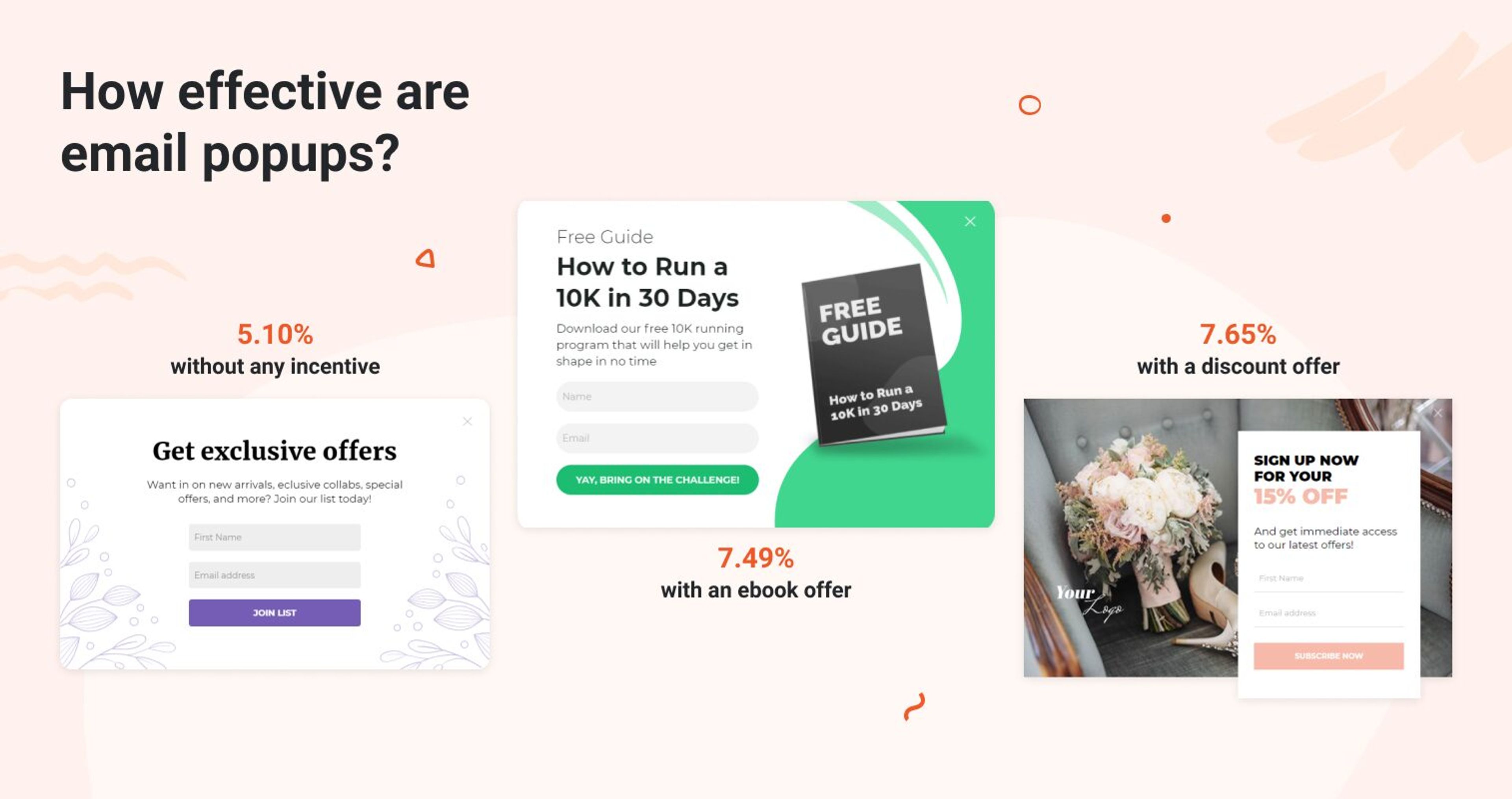
Popups tied to intent (like cart abandonment) often convert far better than generic newsletter forms because they catch users when motivation is high.
Device matters. And surprisingly, mobile popups tend to outperform desktop in many cases.
This suggests mobile users may be more responsive to opt-in offers—especially when the experience is smooth and the value is clear.
If you're relying solely on embedded signup forms or in-content calls-to-action, expect lower conversion rates:
AI continues to reshape how we connect with subscribers.
In fact, 39% of marketers say that AI-powered hyperpersonalization is having the biggest impact on their email results.
From dynamic content to predictive recommendations, AI is helping brands send smarter, more relevant emails at scale.
Let's see what’s gaining momentum in 2026.
Customers don’t stick to just one platform. Omnichannel orchestration means connecting your email with SMS, web push, and other channels to create a smooth, consistent experience no matter where your audience engages.
Smarter data means better targeting. With improved analytics and enriched customer profiles, you can segment more accurately and send messages that truly resonate.
Email is playing a bigger role in keeping customers around. Integrating customer loyalty programs into your email flows lets you reward subscribers with personalized offers and keep them engaged long-term.
Automation is getting an upgrade. AI is now powering workflows that adjust in real time based on user behavior, so your emails can respond to what people actually do, not just what you expect them to do.
Timing matters. With predictive tools, you can send emails when each subscriber is most likely to open and include content that matches their interests, increasing your chances of conversion.
So, what should marketers actually do with all these email marketing stats?
Here are the key takeaways you can’t afford to ignore in 2026:
To put it simply: smarter emails get better results.
Start by defining a clear goal for each campaign, whether it's sales, sign-ups, or re-engagement. Then, segment your list based on behavior or interest, personalize your message, and make sure your timing aligns with your audience’s habits.
Strong email marketing campaigns combine smart targeting with valuable content and a compelling call-to-action.
The right email marketing software should match your goals and team size. Look for features like automation workflows, segmentation, A/B testing, mobile-optimized templates, and real-time analytics. Bonus points if it integrates with your ecommerce platform, CRM, or personalization tools.
Ease-of-use and reliable deliverability are non-negotiable.
It depends on your business size and goals, but email marketing remains one of the most cost-effective channels.
Your budget should account for software, list-building tools (like popups), design or copywriting resources, and possibly third-party integrations or consultants.
If you're spending on ads or influencers, make sure your email strategy is funded too, since that's where many conversions actually happen.
Email marketing remains one of the highest‑performing channels available. With an average ROI of $36 for every $1 spent, strong engagement rates, and powerful automation capabilities, it consistently outperforms many paid and social channels in both cost efficiency and revenue generation.
Yes, email is just as effective, if not more, in 2026.
Thanks to AI-driven personalization, smarter automation, and better segmentation tools, brands can send highly relevant, timely messages that drive higher opens, clicks, and conversions.
With billions of active users globally, email continues to be a dependable and profitable channel for marketers.
Email isn’t just surviving in 2026; it’s flourishing. By using the right tools, employing smart strategies, and prioritizing personalization, marketing professionals can create email marketing campaigns that deliver outstanding results.
Whether you’re optimizing your email subject lines, crafting high-converting popups, or implementing automated workflows, the secret is to remain relevant, consistent, and focused on the customer.
Now that you have the latest stats, benchmarks, and best practices, it’s time to put them into action.
Your inbox empire awaits.

Learn about email marketing frequency for ecommerce stores. Most send 1-3 emails per week, with frequency adjusted by subscriber engagement and store type.
Let's take a look at the 21 best lead generation software for 2026 and discuss the features that any lead generation tool should have.
In this guide, you'll learn what UTM codes are, how they work, and how to generate UTM links for email, social, and ads.